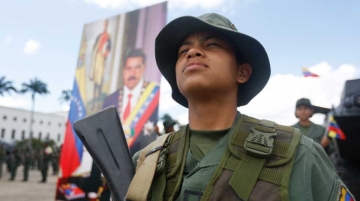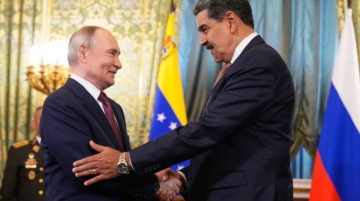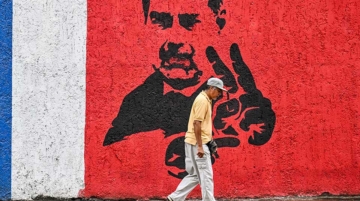
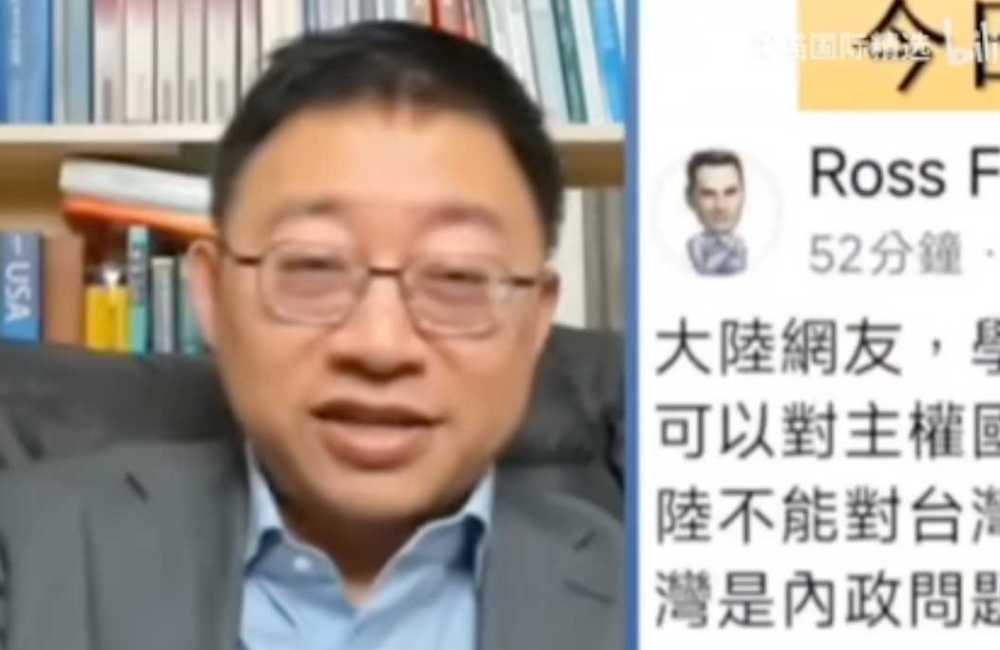
“If the United States can do this to a sovereign country, why can’t the mainland do the same to Taiwan?” Screenshots of the Facebook post by Ross Feingold, the former Asia-Pacific chair of the U.S. Republican Party, circulated widely alongside short video clips of Shen Yi, a professor of international politics at Fudan University, who was interviewed on what the Venezuela incident could mean for China.
In the interview, Shen addressed two questions. The first concerned how political turmoil in Venezuela could affect Chinese investment in the country and across the Western Hemisphere. The second asked whether China might one day follow the U.S. example in Venezuela when dealing with Taiwan.
On the investment question, Shen said uncertainty would likely dominate the short term. The impact on Chinese business interests, he argued, would depend on whether a future transitional government in Venezuela leaned toward Washington or Beijing, as well as on the stance of the country’s military.
Shen emphasized that Venezuela’s armed forces are among the country’s most powerful interest groups. He pointed to Iraq as a cautionary example, arguing that U.S. failure there began not with the invasion itself, but with postwar decisions to dissolve the military, police, and ruling party – moves that directly threatened entrenched power structures and triggered widespread violence.
If the United States accommodates Venezuela’s military, Shen suggested, it may have avoided deploying ground troops. If it does not, he questioned whether pro-U.S. political forces could truly win elections and suppress military resistance. If that were easy, he asked, why had previous U.S. administrations failed to achieve it?
On Taiwan, Shen rejected the premise that China would replicate U.S. tactics.
He broadened the argument beyond Taiwan, asking how countries that rely on major powers evaluate their choices.
Would they prefer a patron capable of forcibly entering a country, arresting its leader, and transferring him abroad for trial? Or a power that presents itself as wealthy, predictable, and inclined to negotiation and shared economic growth?
Shen dismissed the idea of China “arresting” Taiwan leader Lai Ching-te as meaningless. Taiwan, he argued, is not a sovereign state in Beijing’s view, and if China were to use force, it would not involve regime replacement but would mark the end of the conflict altogether. Mimicking the U.S. approach in East Asia, he said, would logically mean targeting leaders of U.S. allies such as the Philippines or Japan.
Shen framed China’s role as one of providing stability in an increasingly uncertain world. The deeper question, he argued, is whether the post – Cold War order moves forward into the 21st century or regresses to 19th-century power politics. In his telling, U.S. actions have already answered that question, while China rejects that path.
Returning to Taiwan near the end of the interview, Shen said the island’s leadership is fully aware of the mainland’s capacity for rapid, precision strikes. Appeals to international law, he argued, offer little protection. What restrains Beijing, he said, is not lack of capability but goodwill toward fellow Chinese.
WHY IS THIS IMPORTANT? Against the backdrop of an increasingly unpredictable and coercive United States, China is presenting itself as a contrasting model. Beijing emphasizes that its rise is intended to provide order rather than cause disruption, a message that lies at the heart of how China seeks to expand its influence in a more fragmented global system.