
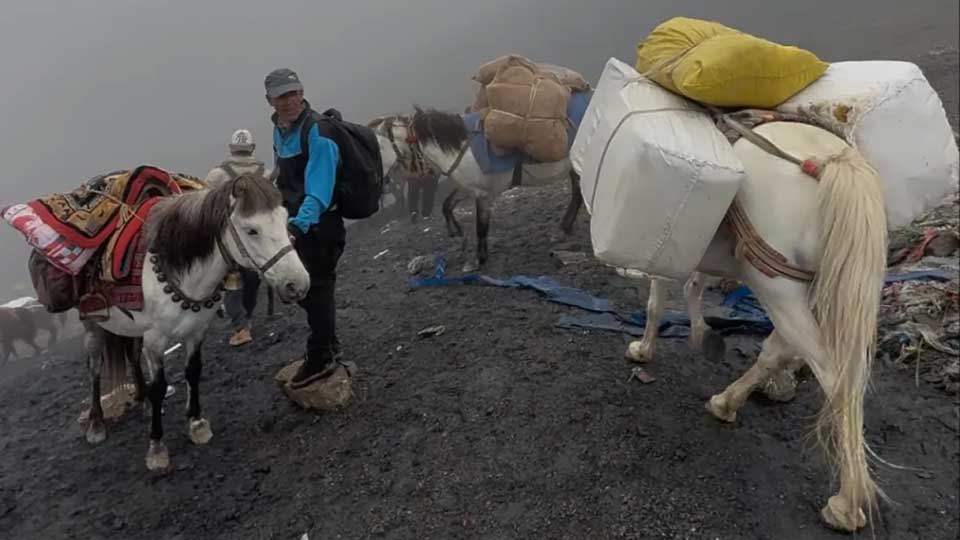
A recent in-depth feature published on the Guangzhou-based renowned newspaper Southern Weekly takes readers into Purang (Burang) on Tibet’s remote Ali Plateau, a tri-border junction between China, Nepal, and India, where one of the Himalayas’ oldest trading systems is still alive. And timing matters: 2026 will be the Tibetan Year of the Horse, the “birth year” of Mount Kailash. Pilgrims from across Asia are expected to surge into the region, a once-in-twelve-years boom that traders see as a rare lifeline.

At the heart of the story is the Purang border market, where Nepali traders and Han Chinese merchants still bargain face-to-face, circling back to each other’s stalls dozens of times a day to dispute a few yuan in profit. Next year may bring the most significant change in half a decade: Indian traders, absent since the pandemic and geopolitical freezes, are expected to return. A new ten-point China–India consensus reached in August 2025 opens the door to reviving traditional routes such as Purang–Gunji.
Yet this revival comes just as the ancient business model is being shaken. E-commerce and streamlined logistics now send bulk goods from factories in China directly to Kathmandu, cutting down costs and eroding Purang’s former advantage. Price comparisons are constant, and the “information gap” that once protected small traders is shrinking fast.
But for many Nepali merchants, digital disruption simply cannot replace what Purang provides. Unlike traders in Kathmandu, many of them come from extremely remote Himalayan villages — places just 30 kilometers from the border by air, but separated by two days of treacherous mountain paths with no roads, no state investment, and no safe alternative routes. In these communities, families have walked the same ridgelines for centuries, crossing into Purang to exchange local rice, timberware, and spices for Chinese goods they cannot source any other way.
Bulk shipments sent to Kathmandu do not reach these villages. Neither do online platforms. Their only viable trade link is Purang and the small mainland Chinese merchants who make the journey to this remote border market each year. That relationship is intimate, habitual, and irreplaceable: built on credit, face-to-face trust, and generations of mutual dependence.
The article traces this fragile ecosystem across time: from Nepali families who have traded here for ten or more generations, to Chinese traders from Gansu and Sichuan who carved their own routes into the plateau in the 1990s, choosing the Himalayas’ thin margins over the risks of big-city retail.
WHY IS THIS IMPORTANT? Set against an approaching pilgrimage boom and the uncertain return of Indian merchants, the piece reveals a centuries-old frontier marketplace at a crossroads — squeezed by geopolitics on one side and modern logistics on the other, yet still holding together a small world of people for whom this border is not just a trade route, but a lifeline.