
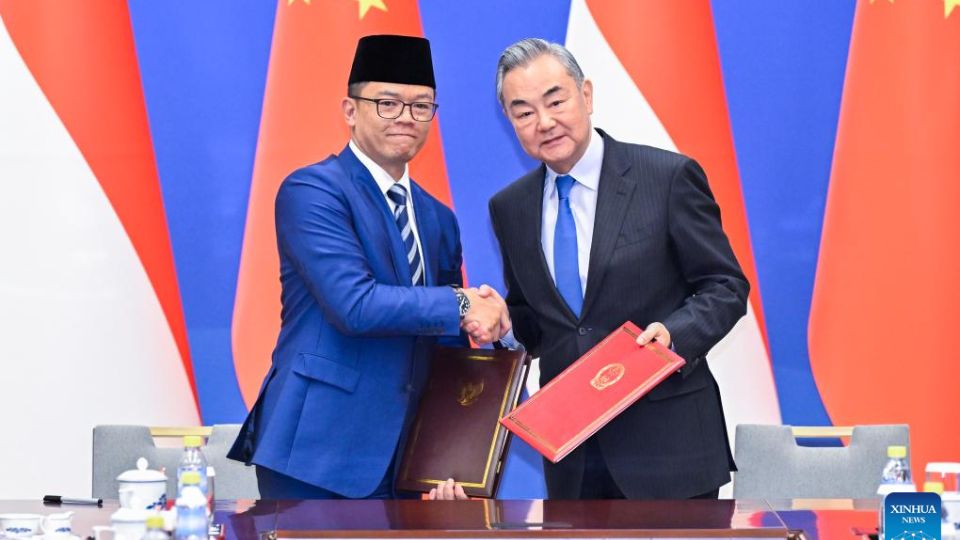
China’s first-ever 2+2 ministerial dialogue with any foreign country took place yesterday — and it wasn’t with Russia or Pakistan. It was with Indonesia.
The meeting, held in Beijing, brought together Indonesian Foreign Minister Sugiono and Defense Minister Sjafrie Sjamsoeddin with their Chinese counterparts Wang Yi and Dong Jun.
The timing, symbolism, and substance of the meeting suggest that China is seeking to strengthen its strategic positioning in Southeast Asia amid heightened U.S.-China tensions.
At the same time, Indonesia signaled that while it is open to expanded strategic engagement with Beijing, it remains firm on safeguarding its core interests, particularly in matters related to maritime sovereignty.
“This dialogue provides a strategic space to align steps, strengthen mutual trust, and design a new direction for Indonesia-China cooperation moving forward,” said Foreign Minister Sugiono.
At the heart of the meeting was the signing of a new Memorandum of Understanding to establish a Comprehensive Strategic Dialogue (CSD) — a mechanism that will structure future engagement across five pillars: economy, people-to-people relations, maritime, politics, and security.
China’s Foreign Minister Wang Yi hailed the 2+2 format — which brings together foreign and defense ministers — as a sign of “the high level of strategic mutual trust between the two countries,” and a cornerstone in building what he called a “China-Indonesia community with a shared future with regional and global impact.”
South China Sea in the Room, Without Being Named
Despite carefully avoiding direct references to the South China Sea in their formal remarks, maritime issues remained a key focus.
Indonesia and China signed documents on maritime security, and agreed to strengthen coordination between Indonesia’s Maritime Security Agency (Bakamla) and the China Coast Guard.
“Maritime cooperation must have a real impact on the people and contribute to regional maritime security,” Sugiono said.
China’s Wang Yi added: “We agreed that safeguarding peace and stability in the South China Sea is in line with the interests of all parties, and we will set up an example in maritime cooperation.”
Analysts say Jakarta’s messaging is no accident. “Indonesia appears to be distancing this meeting from any direct association with China’s claims in the South China Sea,” said Achmad Syarief, a Southeast Asia analyst and doctoral researcher at Johns Hopkins SAIS, to the China-Global South Project.
“Wang Yi also seems to recognize that this is not the right time to raise the region’s most sensitive issues — especially following Xi Jinping’s recent visits to Malaysia, Vietnam, and Cambodia.”
Defense Deepening, but No Blank Checks
The two sides also announced plans for joint counter-terrorism exercises later this year and the creation of a new consultation mechanism on disarmament, non-proliferation, and arms control.
Chinese Defense Minister Dong Jun said Beijing wants to “build a new pattern of defense and security cooperation characterized by deeper strategic mutual trust, better institutional frameworks, more robust coordination, and stronger foundation in addressing challenges.”
Sjafrie, Indonesia’s defense minister, responded in kind but kept a regional focus: Indonesia, he said, is “willing to enhance cooperation with China in fields including defense and maritime security to maintain regional peace and stability.”
Professor Anak Agung Banyu Perwita of the Indonesian Defense University told the China-Global South Project that he supports enhancing maritime security cooperation between the two countries, stating it could help “reduce the risk of open conflict in the South China Sea or North Natuna Sea.”
According to Perwita, military education exchanges between military education institutions and China are becoming increasingly important. “The exchange of defense scholars between the two countries must also be further reinforced in the future.”
Balancing Act With China and the U.S.
Despite the flurry of bilateral agreements, Sugiono took pains to stress that Indonesia wants to maintain “balanced and constructive” ties with both China and the United States — even as a fresh wave of Trump-era tariffs looms.
Sugiono warned that “the tariff war” is already having an impact on the global economy and emphasized the importance of dialogue between the world’s largest economies. “Both China and the United States are important partners for Indonesia’s development,” he said.
Achmad Syarief said the broader region is watching this closely. “Indonesia expects China to continue importing and keeping its economy active so that Indonesia—and similarly, Malaysia and Vietnam—can sustain export growth,” he said.
“But China’s own economy is significantly dependent on its major consumer markets, especially the United States. This creates a chain of interconnected economic interests.”
With the U.S. reportedly preparing for more trade pressure under a potential second Trump administration, Southeast Asia is bracing for fallout. “Trump wants China to make visible concessions, which he can frame as a political victory at home,” said Syarief.
“But Xi Jinping is unlikely to comply — such a move would risk making him appear weak domestically. Given China’s slowing economic growth, any perceived capitulation could undermine his political standing.” said Syarief.
Diplomatic Symbolism, Real Stakes
The visit was also rich in symbolic gestures. Sugiono announced that Indonesia will open a new Consulate General in Chengdu in 2025, as part of efforts to bolster services for Indonesians in Southwest China. And to mark 75 years of diplomatic relations, Jakarta and Beijing jointly launched a commemorative stamp and envelope series.
Wang Yi underscored the role of the two leaders, noting that Presidents Xi and Prabowo have met twice in the past year and “jointly outlined a blueprint for the development of China-Indonesia relations in the new era.”
Still, for Indonesia, symbolism has its limits. “This meeting is a follow-up to last year’s discussions, which created concerns over President Prabowo’s statement on joint development in the South China Sea,” Syarief said.
“The remarks raised apprehension among Southeast Asian countries with territorial disputes with China, and domestically sparked fears that Indonesia might be indirectly acknowledging China’s claims in the area.”
This time, Indonesia made sure not to send that message again. The next 2+2 meeting will be held in Indonesia in 2026.
