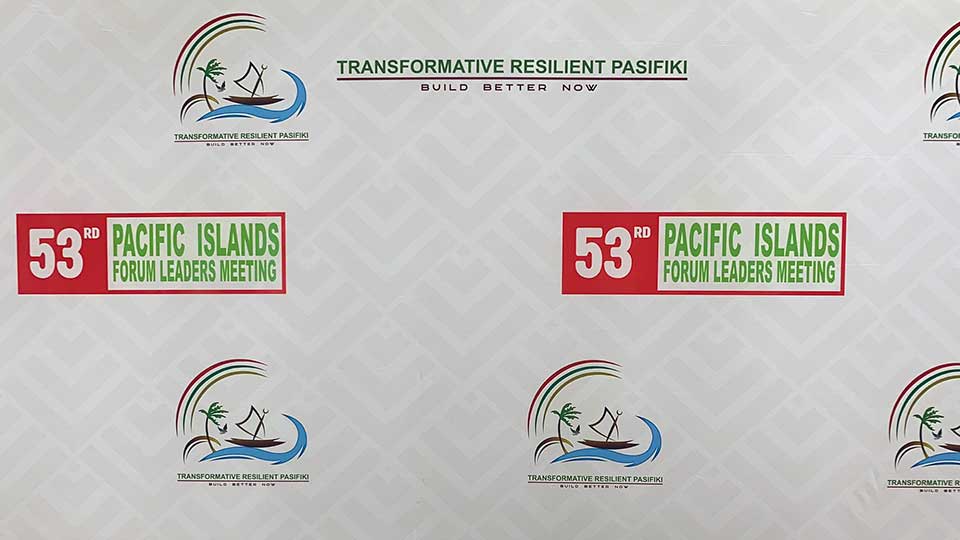
The top summit for Pacific island nations opened Monday in the Kingdom of Tonga, drawing global attention to the region’s climate plight and its role in an unfolding great power rivalry.
Melodic Tongan choir singers and dancing school children in traditional dress welcomed foreign leaders to the seaside capital, Nuku’alofa, for this year’s Pacific Islands Forum.
Beneath the bonhomie, however, rare fissures have been forming in the 18-member bloc with potentially far-reaching consequences.
Pacific nations are torn over China’s security ambitions in the region and are also split on whether to pursue deep-sea mining.
“We gather at a pivotal time in our region’s history,” said forum secretary Baron Waqa, a former president of Nauru.
“We are at the center of global geopolitical interest. We are at the forefront of a battle against climate change.”

China’s influence was evident in Tonga, nicknamed the “friendly islands,” long before Waqa cleared his throat to speak.
Red-and-white signs tacked up outside construction sites in Nuku’alofa tout “China Aid” and visions of a future “shared” with the Pacific’s last monarchy.
One of these projects was the indoor stadium hosting the conference, a US$25 million gift from Beijing.
Chinese ambassador Liu Weimin handed Tonga’s prime minister an oversized novelty cheque at a ribbon-cutting ceremony to open the building.
“China-Tonga relations have grown from strength to strength,” Liu said.
“Friends in need are friends indeed.”
Tonga’s debt-laden government is seen as particularly vulnerable to economic pressure from China.
It owes China’s export bank around $130 million, almost a third of its GDP.
“We need to remain vigilant on regional security issues,” warned Waqa, who has taken a dim view of the escalating rivalry in the past.
The United States has dispatched senior diplomat Kurt Campbell to lead its forum delegation.
Campbell has been one of the key figures behind a US-led push to limit China’s Pacific ambitions.
New Caledonia Crisis
The other pressing security challenge facing Pacific leaders is the unresolved crisis in the French territory of New Caledonia, which quickly reared its head on opening day.
“We must reach consensus on our vision for a region of peace and security,” said Tongan Prime Minister Siaosi Sovaleni.
“We must honor the vision of our forefathers regarding self-determination, including in New Caledonia.”
Much of New Caledonia’s ethnically Melanesian Kanak population fears that Paris’s recent voting reforms could crush their dreams of independence.
It is a cause that resonates widely in the Pacific bloc, which is stacked with former colonies now fiercely proud of their hard-won sovereignty.
Save the Pacific
UN Secretary-General Antonio Guterres fronted the summit in a rare appearance designed to highlight the Pacific’s myriad climate threats.
“The decisions world leaders take in the coming years will determine the fate, first of Pacific Islanders, and then everyone else,” Guterres said.
“If we save the Pacific, we save the world.”
Leaders are expected to renew their push for a homegrown climate adaptation fund, an idea that has stalled as much-needed foreign contributions dry up.
They will also mull over coal-heavyweight Australia’s bid to host the COP climate conference in 2026.
The fractious topic of deep-sea mining does not appear on any official agenda, but it will likely be the subject of heated debate behind closed doors.
Forum host Tonga is at the vanguard of nations eager to open up the emerging industry, joined by fellow forum members Nauru and the Cook Islands.
However, others, such as Samoa, Palau, and Fiji, see it as an environmental catastrophe in the making and fully support an international moratorium.