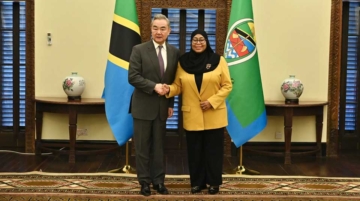

While global attention was fixed on the fallout from U.S. intervention in Venezuela and rising tensions between Washington and Tehran, Chinese Foreign Minister Wang Yi quietly toured three African countries in a notably low-profile visit.
Eric, Cobus, and Géraud unpack why this understated trip mattered despite attracting little media attention, and examine its timing alongside a controversial BRICS naval exercise held off the coast of South Africa.
📌 Topics covered in this episode:
- Why Africa remains China’s first diplomatic stop of the year
- Wang Yi’s low-key tour: Ethiopia, Tanzania, and Lesotho
- Somalia–Somaliland tensions and China’s security calculus
- Ethiopia diplomacy, development messaging, and AU signaling
- Tanzania’s political reassurance and legacy infrastructure ties
- Lesotho market access, tariffs, and geopolitical symbolism
- BRICS naval drills off South Africa and U.S. backlash (AGOA/G20)
- China’s zero-tariff push vs. Africa’s limited export gains
- Bandung 1955: why Asia–Africa solidarity faded, and what could revive it
- Indonesia parallels: Chinese-built infrastructure and nickel-sector controversies
- Public opinion shifts: pragmatic views on China and declining U.S. appeal
Transcript:
ERIC OLANDER: Hello and welcome to another edition of the China in Africa podcast, a proud member of the Sinica Podcast Network.
ERIC OLANDER: I’m Eric Olander, and today I’m joined by CGSP’s Head of Research, Cobus van Staden, and our Head of Africa Programming, Géraud Neema. Today, not either from Cape Town or the beautiful island of Mauritius, but together, all of us in Jakarta, Indonesia, a very good evening to both of you.
COBUS VAN STADEN: Good evening.
GERAUD NEEMA: Good evening.
ERIC OLANDER: We’re going to talk about why we’re in Jakarta and what we’ve been doing here later in the show to really bring back the Bandung spirit of 1955 and the Asia-Africa Conference. We went down to Bandung to see where it all took place, and I’m really curious to hear Cobus and Jeroen’s impressions.
But first, we’re going to talk about the visit by Chinese Foreign Minister Wang Yi to three, not four, African countries in his first overseas visit of the year. Now, it is the 36th year in a row that a Chinese Foreign Minister has made the first visit of the year to Africa, and they start their overseas travels on the continent. And then we’re going to talk about a very controversial naval military exercise that took place off the coast of South Africa with BRICS members.
And finally, again, a little touch base on what we’re doing here in Indonesia. Jeroen, all week last week, you were writing about Chinese Foreign Minister Wang Yi’s visit. You also produced a beautiful infographic that we’re going to be publishing, looking back on the 36 years.
Before we get into why he didn’t go to all four countries and only went to three countries, and those were Ethiopia, Tanzania, and Lesotho. He did not go to Somalia. Maybe give us the highlights of the trip and what you thought stood out this year.
GERAUD NEEMA: So it was a really interesting trip because, as everything that stands out when it comes to those trips, it’s the regularity. I think that it’s something that people who’ve been following us have noticed that it’s kind of a repetition that we say that. But I think it’s always important to remember that to remind how much regular China has been into those trips when they make those trips to China and the foreign minister making a point to make Africa the first stop they make.
And this year, unlike the other year, there was no other stop before coming to Africa. So you really came straight from Beijing to Africa. So it was really a good trip.
It really was the first overseas visit of the year. The very first overseas trip. The main point that we have in those stories was basically diplomatic, as we know, that diplomatic trip with the engagement in Ethiopia, that we’re going to continue supporting Ethiopia, industrial development, infrastructure, and China’s commitment is really to accompany Ethiopian development in Lesotho.
Not much of a coverage over there, but we also see presence there where China support bilateral agreements. They talked about the tariff that China is going lift it up to allow Lesotho to get to China’s markets in Tanzania. It was really interesting.
The trip in Tanzania was really paying attention to that because Tanzania had experienced a very turbulent period in the last couple of months with the election. And when we know how much China is politically invested in Tanzania with the leadership school, and I could only imagine how there was a bit of worriedness in Beijing, how after the election, how things were going on there. So I think that the trip in Tanzania was also a sign of like, let’s go talk to a partner country to see how things are going and to reassure them that we are still together and we’re still moving forward together.
But it was a lot of diplomatic platitude, not really much of a depth of like what people would expect that, you know, we were expecting a big announcement. But just like we said last year, those diplomatic platitudes are always important. It’s diplomacy, just like that grand walk to be there every day to meet the head of state, to meet foreign dignitaries, to meet colleagues from the foreign affairs ministry, and talk about the bilateral relationship between the two countries.
ERIC OLANDER: Yeah, Cobus, no big announcements on this trip, as Jiro pointed out. This was really just run-of-the-mill, day-to-day, on-the-ground diplomacy. It’s not always fancy.It’s not always elegant. It didn’t generate much international coverage, by the way.
Very few international media outlets covered it at all. He did make a few announcements in Ethiopia and in Tanzania. I guess the thing that stood out was he backed the president after a controversial election where she won 98% of the vote.
The West was very critical of those outcomes. So that very much seemed like he was signaling to the West, back off, we’re here, we support the president. What was your takeaway from the three stops?
COBUS VAN STADEN: Yeah, it was interesting. As you say, it was almost like a feeling of diplomatic maintenance going on. It was really about ensuring that the relationship stays at a basic plateau rather than escalating.
It was interesting in Lesotho, they announced that they’re upgrading the relationship, but it wasn’t 100% clear to me what they’re upgrading it to. Xinhua was a little bit vague, particularly since we already know that the different greats of China’s diplomatic relationships were impossible to understand. But we’ve put in a lot of work to try and do that.
But it wasn’t one of these kind of like moving up the grade to a strategic comprehensive, et cetera, et cetera kind of partnership. It just said that they’re upgrading it to work better together. What was also funny, a little bit funny for me was that in a moment where you could really see the work of bringing the two different diplomatic languages together, because there was a paragraph in Xinhua where they said it’s very important to promote human rights.
And yet it’s also important not to weaponize human rights as a way to interfere in other countries. So it’s like, it was very interesting to see the two talking points kind of combined. But yeah, in general, the feeling is that there was a strong feeling for me that everyone knew and China also knew that no one was really focusing on this.
Venezuela was happening at the same time. There’s a lot of other more extreme things kind of in the air. And this was one of those trips to make sure that the Africa-China relationship is cool.
And so we’re moving on.
ERIC OLANDER: And it comes back to, and we hear this over and over again, just showing up is very important. Coming consistently, as Gero pointed out, is also very important. Before we move on though, Cobus, Wang did make some outreach to South Africa when he was in Southern Africa.
That again felt like it was a signal to the U.S. because the U.S. has specifically targeted South Africa for a number of issues and really made the relationship contentious. Tell us a little bit about the outreach that Wang made to your home country.
COBUS VAN STADEN: You know, his visit to Lesotho and the call to South Africa like overlapped in a way, you know, kind of because Lesotho of course is basically surrounded by South Africa. But at the same time, Lesotho was singled out for, you know, for particular kind of high tariffs and general kind of insults from the Trump administration. And then they also had the big fight with South Africa, of course.
So, you know, he congratulated South Africa on the G20 process, obviously in that way, you know, giving a vote of confidence from China to South Africa, which is now essentially cut out of the U.S. next leg of the G20 process. And also essentially, you know, congratulated the ANC again, like China’s always very, very interested in milestones and anniversaries, you know, so this kind of like congratulating the ANC on their birthday, essentially, or their anniversary is also highlighting the continuing ongoing, you know, kind of like presence of the ANC and the CCP as partners and, you know, their joint kind of like status as long running kind of central parties.
So in that sense, you know, it is this interesting, yeah, as you say, kind of a vote of support to South Africa, a general kind of like signal to the U.S., but at the same time, also a part of this kind of party-to-party connection, you know, and maintaining that long-running connection.
ERIC OLANDER: Yeah, the signals coming from China in South Africa, both from Ambassador Wu Peng and now from Wang Yi, in the call with South African Minister of International Relations and Cooperation Ronald Lamola that took place is just, again, I think they’re saying, we’re in your corner, we’ve got your back. You know, I don’t know what that means in practical terms. Obviously, it’s the largest trading partner for South Africa, but it’s also, again, this ideological alignment.
And that’s, of course, what’s upsetting the Americans, which we’ll get into that as well.
GERAUD NEEMA: How far do you think they could go in that support? When we have all this G20 conversation and all the exclusion, do you really see them going beyond just a phone call of support and really pushing even further to what we might, what might happen later this year?
ERIC OLANDER: Well, at the G20 side of things, remember that this is a consensus-based organization among the 22 members, if I, 21 members, sorry, with the African Union now being a new member. So the United States, despite its rhetoric, does not have the right to unilaterally expel South Africa from the G20. And so China can make it very clear that it will not vote to expel South Africa from the G20, something, by the way, that the African Union should be doing, wouldn’t you think?
But anyway, we can get back to that. Cobus, your quick take on this.
COBUS VAN STADEN: Yeah, you know, kind of, I also saw it as, you know, both China and South Africa came out pretty sharply against the invasion of Venezuela. You know, South Africa was one of these countries that ended up getting quoted again, as you know, South Africa always is, in, you know, again, criticizing the Trump administration. And so, you know, so in that sense, like, there’s nothing, I think, particularly concretely that China can, you know, do except giving support, you know, kind of for South Africa in this particular situation, because South Africa’s current situation in the G20 is so unprecedented in the G20 history.
So there isn’t really much more that China could do than just express support and kind of lobby. But it also, I think, had the secondary effect of, again, consolidating them as two very prominent global South voices who are, you know, in agreement on these larger issues, both G20 and Venezuela.
ERIC OLANDER: Well, while he was in Southern Africa, in Lesotho, Wang also made a second call, this to the foreign minister of Somalia, Giroud. Now, that’s interesting, because Somalia was actually on the itinerary, but it ended up being just a phone call. Why?
GERAUD NEEMA: Because for reasons that are still kind of unknown so far, because both parties are kind of putting out different kinds of reasons, because on the Somali part, they talk about technical issues. In China, they say it was just a postponement. And then they talk about security risk and assessment, all of that.
For those reasons, Wang did not make the stop in Somalia. And that was, I think, a big thing, because it’s coming to a moment where Somalia is in the midst of geopolitical tension, where you have Somaliland being recognized. And when we know that China is still protecting Somali integrity, you know, no division and all of that, Wang’s trip in Somalia would have been a vote of confidence that I think that Mogadishu was expecting, you know, in the midst of all this tension, having Wang being there, being present.
And I bet you the call he’s visiting Somalia would have been on the note of, like, respecting sovereignty, respecting territorial integrity, that Somalia is one, that China stands firmly behind Somalia, one Somalia, and all of that, as just Somalia did for Taiwan and all of that. So he did not make the call, he did not make the trip, but he ended up making the call, trying to say that. And in the call, he mentioned, according to the readout, he mentioned the fact that one simple event should not be a defining factor in the China-Somalia relationship, not because we didn’t come.
It doesn’t mean China should not be signaling anything; it simply means China is still firmly standing behind Somalia in this difficult time. So that was basically what happened in Somalia. And we don’t know if next year, maybe there’s going to be a correction and having him being present.
But I’m expecting to see during 2026 to see other Chinese diplomats making the trip, including to Somalia, during those trips.
COBUS VAN STADEN: Did either of the two of you see what or, like, get any clue of what the specific security problem was? Like, I only saw the language of just general security problem, like nothing was specified that I saw.
ERIC OLANDER: Some of the reading that I was seeing was that obviously there were threats being placed by al-Shabaab against the presence of the Chinese foreign minister coming. That was, again, that’s all speculation, because it didn’t come from any official sources. Also, some of what I was reading was that Wang’s plane made that decision very much at the last minute.
So they were intending to go and then it was diverted to Tanzania. So this was a pretty sudden decision that they had to make on the ground. And clearly, their security advisers did not think that he was going to be safe in coming to Somalia.
So, Geraud, I’d be interested to hear what you think.
GERAUD NEEMA: And it seems that the Chinese embassy in Somalia is not involved in a complete, full, safe situation and context, in a full installation where they are in Mogadishu. They still kind of live with what the readouts say. They lived in a container-like situation in Mogadishu.
So the Chinese diplomats are not really in a position to do a good job of preparing for his visit and all the assessments. I just think that, I believe that the decision to go to Mogadishu was kind of planned in the context of geopolitics. You know, the diplomacy wants to make sure that China supports Somalia because it’s important.
But at the same time as well, the situation on the ground was like, you know, we don’t want to put you in a situation where anything can happen because after all, it’s Mogadishu, after all, it’s Somalia. And knowing how al-Shabaab did in 2015 against and where we had Chinese diplomats being killed, I think that the risk was just like, the uncertainty of what could have happened was just too high for them to ignore. That’s why they decided just to put the stop at pause and just maybe to rethink it, what could be, what would come next time.
COBUS VAN STADEN: Yeah, I mean, you know, the discussion around the secession of Somaliland and, you know, the recognition by Israel of Somaliland and so on has to also unfortunately take into account this reality that Somalia remains a really dysfunctional place.
GERAUD NEEMA: Exactly, exactly. That’s going to become a very hot topic during this year in 2026, because we should be expecting that there’ll be a lot of lobbying happening in Washington, having Washington to recognize Somaliland. And that’s why in Mogadishu, having Wang Yi in January would have been a moment where we should have been expecting Mogadishu asking Beijing to be, you know, when that topic come into the United Security Council, we want you really to back us up on that topic.
ERIC OLANDER:
It’s dead on arrival when it comes to the UN Security Council. Doesn’t matter what anybody does, the Chinese are going to veto that outright. Exactly, yeah.
And I don’t even think the Russians are going to support anything like that, because the Russians will have the Chinese back on this. But it was interesting to see on X, the reaction from so many of the Somalia haters in the US who were very smug about Wang not being able to go to Mogadishu. It was a bold move, to say the least.
So I credit the Chinese for giving it a try. It was a bold move, to say the least. Let’s get some final thoughts from both of you before we move on.
Geraud, what’s the takeaway from this year’s visit?
GERAUD NEEMA: The takeaway for me has been one of the main takeaways, always consistency. I look at those trips and I’m really fascinated on how they manage, because compared to last year, I have to admit that this year I was a bit kind of worried. I was like, OK, last year by the first week of January, we already had the time, the dates, the countries, but first week, nothing.
Is he going to make the trip? What’s going to happen? And all of that.
But suddenly we just had on, there was an announcement on January 9th, he’s going to make those trips. And this is something that I’ve been thinking about a lot. Why about those trips?
We never have an announcement that comes ahead of time. We always have an announcement one day or the very, very first day when he starts things. It’s really kind of surprising to me.
ERIC OLANDER: That’s just the way they do things. But even with FOCAC, remember COBUS in the 21 FOCAC, we didn’t know the agenda. We didn’t know anything until 24 hours before it started in Dakar.
So that is just the way the Chinese do things.
COBUS VAN STADEN: But even the Xi-Trump bilateral summit ended up actually only really officially being announced on the Chinese side literally about two days before. It was like, you know, yeah, that’s somehow how they do it.
GERAUD NEEMA: But the only difference is the fact that at least on the Trump side, it was announced, but on the African side, you never have any single African country announcing that we’re going to have the Foreign Affairs Minister.
ERIC OLANDER:
No, they’re very disciplined. They’re very, very disciplined. And remember, even in the run-up to the forum on China-Africa cooperation, all the African governments were very disciplined about whether it was going to be a ministerial gathering or a summit.
We didn’t know. And so that’s just the way they do. So I admire the message discipline that they’re able to instill.
Cobus, after he left Africa, he went to Colombo, Sri Lanka. Did that stand out for you?
COBUS VAN STADEN: It was interesting for me. Obviously, it’s coming at this interesting transition time in Sri Lanka, after big debt problems, after big political problems, natural disaster. And so that, speaking of message discipline, that I saw announced beforehand.
I saw it being discussed in the Sri Lankan press that he’s going to stop there on the way back from Africa, where no African countries were even talking about which African countries he was going to. So that was an interesting difference. Part of that, I think, it overlaps in an interesting way with ongoing, I think, now more commercial engagement with Sri Lankan ports.
Because like after the Hambantota port became this highly symbolic kind of emblem of the entire debt trap narrative and debt trap misinformation, Hambantota port is apparently doing a lot better now. It’s doing a lot more business. And there’s also significant Chinese involvement in Colombo port too.
So it seems like there’s some overlap between commercial engagement and diplomatic engagement at a moment when South Asia is also in a lot of flux. Warming up relations with India, significant complications, and push and pull with Pakistan, warming relations with Bangladesh at the same time. So it was interesting for me that he stopped there.
What did you think?
ERIC OLANDER: And well, I thought it was interesting also because in the context of the China-India relationship that is warming. But just a heads up, we saw some setbacks this week. And again, we’re not going to delve too much into India now because we’re on the Africa program.
But in our Global South show, we’re going to talk about how tensions flared over a region near Jammu and Kashmir and how the Chinese foreign ministry once again kind of set off alarm bells in New Delhi over territorial claims. And so all of this is happening at the same time in South Asia. And by the way, India is also looking to compete for influence in Sri Lanka.
So that is notable for Wang Yi’s visit. But we’ll get to that in our Global South show. I want to bring it back to Southern Africa, Cobus, because while this was all happening, Chinese, Russian, and even Iranian warships who made their way, I think the Iranians made it but didn’t participate, all got together with a number of other countries from the BRICS coalition to do naval exercises.
Now, this was called MOSI III. MOSI was the South African Defense Ministry’s code word for or operation name for these joint exercises that used to be for MOSI I and MOSI II, just among Russia, China, and South Africa. This year was notable because it also included a number of the BRICS countries that also took part.
Cobus, it caught a lot of flack from Washington, which shouldn’t be a huge surprise. But tell us a little bit about what was going on off the coast of South Africa.
COBUS VAN STADEN: You know, so Wang’s visit, I think, you know, also to Lesotho, also over, you know, kind of overlapped with this, you know, with this kind of work that was happening in Southern Africa. So that was an interesting overlap for me. You know, as you say, it’s all of these different BRICS countries being involved.
The main thing that the main takeaway from the entire exercise ended up being South Africa asking Iran to not participate. So, you know, the poor South Africans are under so much pressure that they decided, I think, that having Iran there is probably a step too far. And it was in the South African press, it was discussed explicitly in terms of trying to get the U.S. heat off them, you know, to try and kind of like de-escalate the situation with the U.S. I don’t think that it didn’t work. It didn’t work. It did not work. So, you know, like it would probably have been a better idea to disinvite them earlier on in the process.
But yeah, you know, it’s always very difficult to say how much of substance actually happens in these military exercises, you know, because the different navies are at such different levels of capacity. People that I know who do a lot more, who are a lot more connected with the navy, the South African navy than I am, have mentioned to me in the past one of the reasons why these exercises tend to happen on the South African coast is because the poor South African navy can’t actually travel that far to go and do it elsewhere. So it’s always very like much more, you know, much richer and much more kind of like well-equipped navies kind of moving down to South Africa and giving South Africa that kind of host role, you know, kind of while the South African naval capability is actually not on there, on par.
And of course, now that it’s a BRICS kind of group, those contradictions become even bigger, I think.
ERIC OLANDER: Yeah. Geraud, let me read you the reaction coming from the Senate Foreign Relations Committee chairman, Jim Risch, a Republican. He was very outspoken in what he saw in these naval exercises.
Quote, South Africa’s ANC-led government’s foreign policy hides behind a claim of non-alignment, yet its military host drills with America’s chief adversaries. Any promise or deal this government offers Washington is meaningless when its actions signal open hostility to the United States. President Trump is right to treat South Africa’s government for what it is, an adversary of America.
That is not very optimistic. And let’s also add one other footnote to this. The African Growth and Opportunity Act this week passed through the House and is now landing in the Senate where Jim Risch is waiting for it.
One of the big questions is going to be whether South Africa will be included in AGOA. South Africa’s trade minister this week was trying to make the case that it is important for AGOA to have South Africa in it. But based on what we’re just hearing here, that South Africa is now an adversary of the United States, according to Jim Risch.
What’s your reaction to all this?
GERAUD NEEMA: At this point, I don’t really know if there is anything that South Africa can do to appease Washington, D.C. It started years ago. We’ve been following that. And with the latest development, I don’t really believe that there’s anything unless South Africa goes far by saying, I’m going to cut ties with China and Russia and I’m going to leave BRICS.
That could really appease and satisfy Washington, D.C. But if they don’t do that, just disinviting Iran or stopping any kind of, it will not satisfy enough D.C. They’re really, they are not in that path of appeasement with South Africa. And we have to acknowledge that South Africa is really trying, as you mentioned, Eric, to de-escalate the situation, to appease Washington, because they don’t want to be disinvited for the G20, because I’m kind of also anticipating the fact that they believe that there might not be many countries to have their back when the moment will come to support them against a disinvitation from Donald Trump.
So they say, let’s find a way to de-escalate that. Let’s show good faith that we are trying. We are not going in on that dark corner of the world where we are really with the enemy of the United States.
ERIC OLANDER: But it’s still going to work. Yeah, but Giroud, I mean, you’re saying they’re trying to de-escalate, but at the same time, as Cobusmentioned, they were one of the most outspoken critics of Venezuela, at the same time as hosting naval exercises with China, Russia, and then Iran was on the guest list, but didn’t really make it, but nonetheless was not disinvited in time. And so it’s not inaccurate.
It’s actually quite true that they were hosting naval exercises with America’s chief adversaries. So it doesn’t feel, I think in Washington, it doesn’t feel like they’re trying to de-escalate when in fact they’re issuing statements that are counter to U.S. interests, whatever we think of U.S. interests right now. But it feels to me, Cobus, that the trade minister’s appeals for being included in AGOA are, I mean, just, it seems helpless at this moment.
I mean, it just doesn’t, I mean, when you have the view in Washington coming from someone like Jim Risch, and then, and let me just add one more thing that he wrote, Cobus, to get your reaction, that is why the U.S. should take stronger action against the South African government. The time for envoys, bureaucratic reviews, or business deals bridging the gap has passed. Cobus, it seems like we are going into a new era in U.S. South Africa relations.
COBUS VAN STADEN: As someone who lived through, as a teenager lived through the transition to, you know, to democracy at a time when South Africa was the most, you know, the most celebrated, you know, of global South countries in the U.S., you know, remember like Nelson Mandela was there wearing a New York Yankees jacket, throwing out the first pitch, you know, kind of at Yankee Stadium. This is quite disturbing, I have to say, like, you know, kind of, but particularly because South Africa has its problems, but South Africa isn’t some, isn’t a Myanmar-style, you know, military junta, like, you know, kind of bombing its own people, you know.
ERIC OLANDER: Well, not according to President Trump. I mean, let’s be, let’s be clear here. President Trump seems convinced that there is a white genocide going on in South Africa.
COBUS VAN STADEN: Yes.
ERIC OLANDER: So if that’s the case, I know there isn’t one, but in his world and reality, there is. This is, we live in a meme-driven world. And I don’t know if he believes it or not, but that is the reality that we’re confronted in terms of the policy of the United States government, which is based on the fact that there is a white genocide going on in South Africa, regardless of whether there’s evidence or not, which there’s not, of course.
GERAUD NEEMA: And there is something I would like to add since Cobusmentioned Nelson Mandela. Let’s not forget that South Africa has a historical past of, a history of calling out the United States’ foreign policy. That’s not the first time.
Mandela himself called out U.S. foreign policy. Mandela himself in D.C., in the United States, said that we cannot just be aligning behind the United States because the U.S. believes that the enemy, they should be our enemies. South Africa has a past of consistency of like, you know, we’re going to engage with the United States, but yet we’re going to maintain our autonomy in terms of the way we dictate our foreign policy.
They called out the United States when it comes to Iraq, Libya, so many crises. South Africa has always been in the leadership position to call out the U.S. in Africa when it comes to those foreign policies. So for me, it’s not really a surprise, per se.
So just to what you just said, Eric, South Africa, it’s consistent to South African foreign policy. Venezuela was going to be called out by South Africa no matter what.
ERIC OLANDER: Fair enough, though, Giroud. So if that’s the case, and let me just play devil’s advocate here and put on my MAGA hat, then if that’s the case, then sleep in the bed that you made. If you’re that critical of the U.S. for years and years and years, maybe Jim Risch is right. Maybe it isn’t. Maybe we should, maybe the U.S. should treat South Africa as an adversary in that respect. If they’ve been calling out U.S. foreign policy for so long and being such a critic, I mean, I’m not suggesting that, but you can see how that would be interpreted in today’s Washington.
COBUS VAN STADEN: Yes, but the thing is, you know, like outside in the longer history, you know, before our MAGA moment, you know, U.S. foreign policy, particularly after the Cold War, was, you know, largely framed by the U.S. as in line with international law. And, you know, and South Africa is, you know, is South African foreign policy. South Africa is a small foreign policy player, but South Africa punches above its weight as a foreign policy thought leader, because it has a human rights and international law focused, you know, foreign policy approach.
So, you know, so in that sense, South Africa is this ongoing, you know, canary in the coal mine, you know, kind of like it’s small, but its vocalness has value for the international system. And so, you know, so in that sense, you know, it’s doing its job. And the fact that that job is now painting a target on its back, it’s not South Africa’s fault.
It’s, you know, a sign of the radical change in the U.S., you know, which includes, you know, invading and kidnapping a sitting president.
ERIC OLANDER: That’s right, but you may have to accept the consequences of this moral position that you’ve taken.
COBUS VAN STADEN: I think South Africa probably already kind of has, because I think that South Africa has probably given up on being included in NAGOA anyway. And they’ve certainly kind of moved forward in terms of diversifying and looking for alternatives. And, you know, so in that sense, I think South Africa is kind of moving on.
ERIC OLANDER: And let’s remind everybody what AGOA is in terms of with or without South Africa. It’s between 25 and 30 percent, upwards of 40 percent, depending on how you calculate it, that comes through South Africa. So AGOA without South Africa is really kind of meaningless.
I mean, it’s not that much. And that’s maybe the reason why it’ll go through. Let’s not get too diverted onto U.S.-South Africa, given that this is the China and Africa podcast. Let’s quickly focus on two other news events that happened, which I did not brief you on. In Kenya over the past week, there’s been a little bit of confusion over whether a trade deal with China has been put on hold or not. The Standard Newspaper, along backed by Bloomberg, said that out of concern that it would frustrate the United States, the Kenyans put a deal on hold, a free trade deal.
Now, this is what’s been puzzling to me, gentlemen, that Kenya, Ghana and a number of African governments say they’re in talks with China for zero tariff market access into the Chinese market. I don’t quite understand what these talks are all about, because the Chinese announced that all African countries, with the exception of East Suatini, would have tariff-free access into the African market. So I’m not entirely sure what they’re negotiating, but it seems like something is happening.
The Kenyan foreign minister came out later this week and said, no, that’s not true. The Standard got it wrong. In fact, we finalized this deal at the end of last year.
Not entirely sure what’s going on there. So I urge people to be a little bit cautious on this story about this U.S. angle on it right now. The Kenyans are also trying to negotiate some type of market access deal with the United States.
Again, Jim Risch, by the way, upset also with the Kenyans go over their close relationship with the Chinese, given the fact that Kenya is a major non-NATO ally. I think I got that wording right. And so he doesn’t believe that a major non-NATO ally should have close relationship with China.
Any comment on that one before I move on to one other quick story?
COBUS VAN STADEN: Well, this thing about the zero tariffs, I’ve seen this several times. There’s something to do. It seems like even though the zero tariffs for all African countries have been announced, it seems like to actually enact it takes a process with each individual African country.
The South Africans have also been in similar negotiations and have announced several times that they are making a lot of progress now in this kind of zero tariff arrangement, which I still don’t 100% understand. Like you, I also don’t understand what needs to be negotiated when the tariffs have already been revoked.
GERAUD NEEMA: I’m just going to add an element on that. I’m just going to add an element because it’s something I’ve been following since the last FOCAG. It’s part of what China announced in the last FOCAG for the Comprehensive Economic Partnership.
You want to negotiate with African countries to establish a zero tariff policy and to establish a whole set of economic and trade agreement with those countries. Originally, China wanted to make it at the continental level with all the countries, but there were not really many responses from the continental level. So in Changsha last year, they again reiterated the need that we want to negotiate that.
So then they started bilateral discussions, private bilateral discussions that were not really made public until some countries started to talk that we’re discussing the rest of Africa, Kenya, Tanzania, some African countries, Uganda are having those discussions with China on that element exactly. So it’s exactly part of that agreement that those countries are now negotiating with China. It will go beyond the zero tariff to include other elements of investment, of trade and all of a whole much more comprehensive package that China wants to negotiate with those countries.
I just want to highlight that element for people to understand why they’re actually negotiating the part of those agreements there.
ERIC OLANDER: And something to be very clear here, this is not a two-way free trade deal as it is in many countries. So this is not about unlimited duty-free access into African markets. This has been a big topic of concern in Ghana lately, where there’s been a lot of concern from the business community that if they do negotiate tariff-free entry into Ghana, it could have a potentially devastating impact on a number of local businesses.
And the government has tried to reassure the business community there that this is not about tariff-free access into Ghana. This is about tariff-free access into China. So that’s something important.
We also got some trade numbers this week. Again, some interesting thread lines that go through these trade numbers. China registered a $1.2 trillion surplus in 2025, a huge surplus. That is interesting in part because they had to pay a lot more in order to access the U.S. market. Well, they didn’t pay it. U.S. consumers and shippers paid it. But it didn’t seem to impact their overall balance sheet. $6.51 trillion of global trade last year. That is a record.
It makes China the largest trading power in the history of the world. No one has ever traded that much around the world. So that is rather remarkable.
But here’s what’s important for Africa. So we saw a 20% increase in exports that led to that $1.2 trillion surplus, a 0.5% increase in imports. That should be a very worrisome number for a number of global South countries, particularly in Africa, because it means that the Chinese are really not buying as much as they’re selling.
And again, so a lot of talk about China is going to welcome all these imports from all around the world. But the numbers don’t lie. And here we are, 0.5% increase in imports last year. So the promise of selling huge quantities of goods to the Chinese market, with the exception of, say, Brazil and soybeans, that is an outlier. But for most countries, Cobus, this is maybe not as lucrative as a lot of people think it is.
COBUS VAN STADEN: And it seems to indicate that for all of the talk of the green lanes for agricultural imports at FOCAC and all of this incredible kind of infrastructure, trade infrastructure that’s been set up in places like Hunan province, there isn’t yet a boom in African agricultural exports to China. That seems to still be very early days in that respect. So it’s also interesting that even also for all of the talk of China’s death grip on African minerals, that also doesn’t seem to be really increasing that quickly.
GERAUD NEEMA: Let me be cynical about those numbers. This is even, I believe this is the reason why China doesn’t fear the risk of giving zero tariffs to African products, because they know there’s nothing that doesn’t come from Africa that’s going to hurt. It’s like a goa with the Americans.
ERIC OLANDER: They’re not worried about it.
GERAUD NEEMA: Yeah, exactly. They’re not worried about it. Just more about political rhetoric, that use for political rhetoric.
They know that we are not dealing with the super industrial power, manufacturing power that’s going to hurt us. I’m going to give you another fact. Do you know that in Africa you have Mauritius that has a free trade agreement with China?
Only African countries with a free trade agreement with China. What Mauritius trade with China? Almost nothing, because you know that there’s almost nothing from out of Mauritius that’s going to hurt Chinese producer.
ERIC OLANDER: So yeah, so you see that now. Well, let’s close our discussion here in Jakarta. We came to Indonesia this week for our first time ever to have a CGSP company retreat and a meeting where we all get together for the first time.
Normally, we’re little boxes on a screen talking to each other in all different corners of the world. So we thought it would be fun to come together. In part, we chose Indonesia because, well, we’ve got some excellent colleagues here.
I’m out here in Asia. We have a number of colleagues in Asia, and we also thought it would be fun to bring together our colleagues and our staff from Africa to come to Bandung. And today we went to Bandung, the site of the 1955 Asia Africa Conference.
It’s been a fascinating week, and I’d like to get some impressions from both of you as Africans what it’s like to be here in Indonesia, both to see the development story. We took the Woosh train, an $8.5 billion Chinese-built high-speed rail. I’d like to get your impressions of that.
But Cobus, this is a development story. It’s also a lot of important history, as we saw at the Museum of the Asia Africa Conference in Bandung. What are your thoughts and your reflections on a week in Indonesia?
COBUS VAN STADEN: It was fascinating. I mean, I’ve always wanted to visit Indonesia because of the China connection, but also because both South Africa and Indonesia were colonized by the Netherlands. And that kind of network of Dutch colonial exploitation really shaped both countries very fundamentally and bound them together.
So there’s a lot of unexpected linguistic, cultural, ethnic connections between Indonesia and particularly Cape Town. So it’s all fascinating. That history got really kind of amplified for me in going to Bandung and actually going to the actual venue of the 1955 Asia Africa Solidarity Conference, which was incredible to see.
It was quite moving for me to see being in the same kind of venue where it happened with all the flags kind of hanging there. It was very interesting kind of glimpse of that particular moment in 1955 with all of these monumental 20th century leaders of the global South all together in the same room, all talking about post-colonial democracy and what that’s going to look like in a moment of very intense great power rivalry. And now that we are again in a moment of very intense power rivalry, it was really interesting to kind of revisit that.
ERIC OLANDER: And yet that spirit of Bandung didn’t survive. The links between Southeast Asia and Asia more broadly and Africa, with the exception of China to some extent, are quite weak. There isn’t a lot of area studies at universities.
There’s not a lot of exchanges. In fact, our staff, when they arrived at the airport in Jakarta, found it very difficult to get in and were interrogated for three hours. Again, that’s a small instance, but it just shows you the friction that’s there too.
So that spirit of Bandung, it sounds great, but didn’t really survive in the post-Cold War era.
GERAUD NEEMA: Yeah, it was really an emotional moment for a person like me. It’s historically emotional because I read some of the notes, some of the speeches that were made there. And you could really feel that when people were talking, they were really believing that we were really fighting for Asia, Africa, solidarity, fighting against colonialism to stand up together against imperialism.
You read the text of Sukarno, the speech of Sukarno, the president of Indonesia that were making at that time, really great word, profound word, deep word about the future, how the world would look like if Africa and Asia stands together for freedom against colonialism, against imperialism. But yet, yet, it was really strange for me being here in Indonesia, speaking with different partners that we have here, speaking with different intellectual professors and political figures, but yet having the same answer when I asked the question, do you have a structural demand here in Indonesia for an Indonesia-Africa relationship? They say there’s none.
There’s no such demand. There’s no such connect. There’s no such demand here for having that connection happening.
There’s some small initiative here that’s trying to move forward, but you don’t have that demand, that driving force behind in Indonesia. It’s like, how do we connect with Africa? It was really quite sad.
And when we’re in the museum, I even told Corbis, if you had a time machine and if you had an opportunity to go back in 1955 in this conference, would you go back and tell those people, do you know what, all those speeches are good, but 50 years from now, 60, 70 years from now, everything that you got, everything you’re doing here is going to serve for nothing. Nothing will happen. And you’re even going to take your ways apart far from each other.
It was really interesting to see all of that happening and all this history unfolding. But yet when you see the present, it’s a completely different present than they envisioned at that time.
ERIC OLANDER: And Cobus, let’s talk about China-Indonesia relations. And again, it’s interesting to look at that from an African perspective in part, because when we see where Indonesia is on the kind of GDP and the development scale, it’s probably on the upper tier of where African countries are, but certainly below South Africa, Morocco and some other countries. What are your impressions in terms of what you’ve seen of the Chinese presence here?
We see a lot of Chinese cars, BYD, Geely, and Wuling cars are here. You can feel the Chinese presence, you know, on the whoosh train today, which is the Chinese-built train. There was a, an ad for Alibaba’s AI cloud service.
So the Chinese presence here is very strong.
GERAUD NEEMA: I think you should be telling people that the whoosh is not just an expression, it’s actually the name. People may believe that. That’s right.
ERIC OLANDER: So, I mean, yeah, the whoosh is the actual name. And at the end they have this very, the announcements, the women at the, who give the announcements at the end, they go whoosh, whoosh, yeah. And so it’s very cute.
But that is the name, the whoosh, that is the name. But we had a chance to speak with a number of senior policy stakeholders and analysts about the China relationship. Give us your impressions of that as it relates again, from an African perspective, because there are probably some lessons to learn from what Indonesia is doing.
COBUS VAN STADEN:
One of the things that, that Jeroen and I were also talking about in today in Bandung was that, that it remains dismaying that, that there is so little actual, you know, real interchange and contact between Africa and Indonesia because they, they really are on a very similar trajectory, you know, kind of, they really are struggling with some similar things. Indonesia, I think, is further along in some, in key ways, but there’s, you know, kind of things like building infrastructure, for example, is, you know, and electrification remains a real, a real problem. And China is playing a huge, a huge role, you know, kind of in both of their, their, their worlds, you know, in this way.
You mentioned EVs, the other, the other big thing that, that was really prominent in the discussions was electrification. And, you know, there, there is this very interesting overlap where, where both South Africa and Indonesia became these, these pilot countries for just energy transition partnerships with the G7, you know, very, very big financial packages, almost completely loans to, to, to, to do in, in, in both countries, both countries have very strong coal buyers, embedded coal buyers in, you know, kind of in their, in their governments, they’re incredibly coal dependent. They’re both like much heavily more, heavily polluting than, you know, kind of for the amount of electricity they get out of the coal. And so, you know, as part of this kind of general kind of climate kind of overhaul for the rest of the world, like both of these countries got these, these packages from, from the G7 to try and kind of overhaul them.
And the consensus that we, that we got, and this is also what I’m hearing from some sources in South Africa, is that these energy partnerships are essentially dead. That, that, that Indonesia have, have essentially fully given up on the, the just energy transition partnership with the, with the G7 and that they’re now moving towards what they call, instead of jet B, they call jet B, which is just energy transition brotherhood, which is led by China. And, you know, in, in, in the same way, that’s very funny.
I thought that was, they have a sense of humor. And, you know, so, so China, like just, you know, solar power provision from China is, is playing huge role, not only in, in general broad-based electrification in both countries, but in increasingly in both countries also being very significant mineral hubs, you know, in, in the mining sectors in both of these countries.
ERIC OLANDER: Yeah. You took the words right out of my mouth and I wanted to get to Jero on that. Another parallel between South Africa and the DRC, as, as Cobuspointed out, this is a major mineral hub.
This is the DRC of Asia for nickel and South Africa, but this is the major nickel and the Chinese are big actors here, just as they are in the DRC. Jero, since you specialize in critical resource mining and also in mining more generally, what did you think of the conversations that you heard from people about the nickel sector here and the Chinese role in it?
GERAUD NEEMA: Well, it was really interesting because I was hearing them and I had the impression to hear or to read the reports coming from an NGO coming straight from Lubumbashi or from, coming from Koloizi, like the same issue of environmental issue, the same issue of CSRS, the same issue of, you know, transparency, the same issue of corruption, local corruption, national corruption, the same issue of how civil society are fighting to get Chinese companies to do the right thing.
There’s all the same issue, just all the same. So the conversation I had ended up becoming a learning, self-learning experience on how this happened in your country. What do you do?
How this company, the same company that we have here, how does it do in Koloizi? Do they do things differently? And when I told them, you know, they’ve started to improve X, Y, Z or like, what did you do for them to improve?
What happened? What was the context? It was really interesting because I think you’re like, wow, we are exactly similar in every possible way, weather, climate issues and all those kinds of issues.
We are having the same thing and we just don’t talk enough. We just don’t talk enough beyond the government, even between intellectuals. We don’t talk enough to say, let’s think together how we can move forward to address all those issues that we are facing all together.
It was really interesting really to learn that and to see that. And I believe that there is a lot of potential that can be forced in our relationship with Indonesia, not only DRC, but many African countries to foster in Indonesia in a way that how to address all those common challenges that we are having together.
ERIC OLANDER: Yeah, one of the eyebrows really raised quite high among our Indonesian visitors and friends when we told them about how lithium, Prospect Lithium, I think it is, in Zimbabwe is now building a 60 megawatt captive solar power plant to power their lithium processing and mining operations in Zimbabwe because captive coal plants financed by the Chinese here in Indonesia is a very big problem. And so they were very interested to hear more about that. And that’s where we see the potential for these learnings.
And that’s certainly going to be something that we’re going to do more of. So I hope you guys go back to South Africa and to Mauritius inspired about how we can kind of fill that void of communication between Asia and Africa and maybe, you know, single-handedly revive the Bandung spirit ourselves. So if nobody else wants to do it, it’s going to fall on our shoulders to do it.
GERAUD NEEMA: But one common point I wanted to mention as well that happened, the view about China.
ERIC OLANDER: Oh yes, let’s wrap on that.
GERAUD NEEMA: They tell you it’s always complex. They were telling me, you know, the way people see in China, in Indonesia, it’s not the same way they see it like in other part of the country. You have to be in contact on an everyday basis to see, to have an opinion on that.
Most of Indonesia on the average basis, they don’t have a strong for or against view about China. It’s much more complex than New York. And I was telling them it’s exactly the same thing in Africa.
It’s exactly the same thing. That was really interesting for me to learn as well.
ERIC OLANDER: Our friends at CELIO, which is a think tank here, they did an online survey and found that public opinion on China was very pragmatic. People see it as an opportunity. They don’t see it as an ally or threat.
They want to have economic engagement. Two things stood out to me was one, again, how pragmatic it was. And I think that’s echoed a lot of what we see in Africa as well, that people are happy to engage the Chinese so long as there’s an opportunity there and they’ll give them the benefit of the doubt.
The other key takeaway from the survey, and I don’t know if Americans truly appreciate this, is how far and fast the United States has fallen in this part of the world, both because of what Donald Trump has done, and because of the Gaza War as well. And it was fascinating to see how low the United States ranked on so many of the questions. I mean, we’re talking single-digit number responses that faith in the United States has fallen precipitously.
Tell us, you’re going to close us out here, but give us your impressions of the CELIO survey.
COBUS VAN STADEN: Yeah, so it was really interesting. It was also notable how quickly U.S. attractiveness has fallen. It cratered within a year, because they do these surveys every year.
And of course, these crises have been ongoing for longer than that. But even just between 2024 and 2025, there was a marked decline in U.S. attractiveness, in trust in the U.S. And that, I think, for South Africa-specific reasons, is very true in South Africa too. And I think what’s interesting is, I think both countries, it’s notable, because even though South Africa is now being framed as being anti-U.S., I think, popularly, South Africa is actually very pro-U.S. The U.S. has had very high levels of popular love and influence in South Africa for a very long time. And that, I think, is to a large extent also true in Indonesia. And in both countries, all of these crises, particularly the Gaza crisis, which I think has really been taken to heart in both Indonesia and South Africa, more than a lot of other parts of the Global South, have really impacted, I think, the way that these countries think about the U.S. At the same time, even though I think it hasn’t been replaced by a similar kind of multi-level warmth on the China side, China steps into a lot of gaps left by Western power. And in a lot of cases, I think in both countries, it’s seen as the best other option and increasingly a unique option, offering things that no one else is offering, infrastructure and electricity being the key ones. And I think EV is rapidly moving into the third space.
So there, it’s interesting how that is happening, even though both countries don’t have a very close organic link with China. China feels far away, even though Indonesia is obviously Asian, so China is just more in the neighborhood. But even so, it isn’t just in conversations with them, there isn’t a sense that the people just grow up learning Mandarin by default, for example.
And so it is interesting how even in this space of cultural distance, China is now these countries’ really essential partner, against the background of increasing worry and anxiety about shifts in the U.S. Well, I’ll tell you as a longtime resident here in Southeast Asia that China’s presence is felt in every corner of daily life.
ERIC OLANDER: Our e-commerce products all come from China. We use e-commerce websites that are Chinese-owned. Products, our everyday products, the cars now, our phones are Chinese.
I mean, you turn on Netflix in Vietnam, in many countries in Southeast Asia, and it’s the Chinese movies, the algorithms are pushing the Chinese movies right to the top. And that’s all algorithmically driven based on consumer usage, so it’s not even anything that’s orchestrated. So TikTok obviously being an influence, and TikTok shop here in Indonesia is also a big influence.
So, well, gentlemen, well, thank you very much for a wonderful week in Indonesia. We’ll be back in our respective corners of the world next week. It has been fascinating to both explore this amazing country with you, and we had the chance to enjoy, you know, so much of the food.
And we want to give a big shout-out to our colleague, Edward Binsrimo, who really just did an amazing job as our host, our Southeast Asia editor. And so really a big thank you to him. And I want to thank you for listening and for watching.
And of course, if you want to follow the great work that Cobus and Jero and Edwin and the rest of the team are doing around the world, go to ChinaglobalSouth.com. We have subscriptions available if you want to get the great newsletter that Cobus and I put out every week. And you can go there and get it at ChinaglobalSouth.com slash subscribe. And don’t forget, if you are a teacher or a student, we give you half off. Email me, Eric, at ChinaglobalSouth.com, and I will send you those links. We’ll all be back again next week.
So for Geraud and Cobus today in Jakarta, I’m Eric Olander. Thank you so much for listening and for watching.