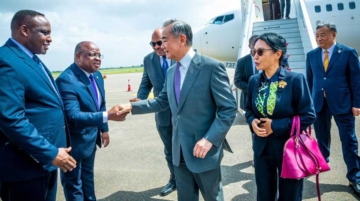
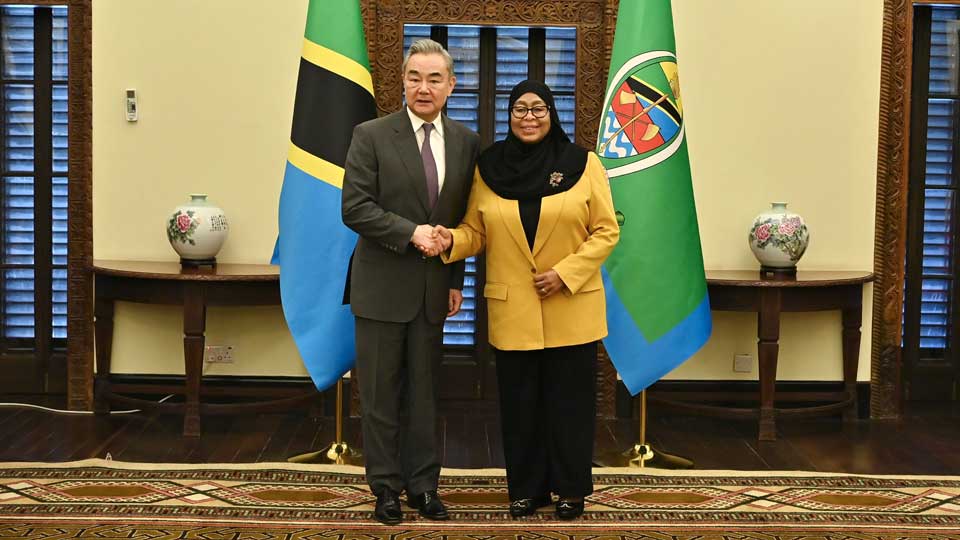
China’s Wang Yi kicked off a four-nation, week-long Africa tour this week, marking a signature tradition for Beijing: making the continent the foreign minister’s first overseas trip of the new year.
Wang visited Ethiopia and will also travel to Somalia, Tanzania, and Lesotho in southern Africa.
Ovigwe Eguegu, a Nigeria-based policy analyst for Development Reimagined, joins Eric & Cobus to discuss why these four countries made the itinerary, and what Beijing may be signaling geopolitically and economically.
📌 Topics covered include:
- Why Africa is China’s first diplomatic stop in 2026
- Somalia Somaliland and great power competition
- Ethiopia debt diplomacy and AU politics
- Tanzania ports and the TAZARA railway
- Lesotho tariffs AGOA fallout and symbolism
- China positioning itself as a multilateral partner in Africa
Show Notes:
- South China Morning Post: China FM Wang Yi opens Africa tour with united call for rules-based order by Jevans Nyabiage
- Reuters: China, Ethiopia pledge closer cooperation in areas from infrastructure to AI
- Bloomberg: South Africa Hosts BRICS Naval Drill, Risks Renewed US Ire by Paul Vecchiatto and Michael Cohen
About Ovigwe Eguegu:

Ovigwe is a Policy Analyst at Development Reimagined. He focuses on geopolitics with particular reference to Africa in a changing global order. Specifically, his work includes policy analysis and publications on how great power politics affect developments in the region; with a special focus on regional/international security, institutions-alliances, and initiatives-projects. Ovigwe regularly features in international media including Al Jazeera, TRT World, CGTN, DW News, and the BBC. His articles have appeared on The Diplomat, Foreign Policy Magazine, and The Africa Report. Ovigwe is frequently invited to policy dialogues, seminars and workshops hosted by leading think-tanks including the Institute for Security Studies, Council on Foreign Relations and the South African Institute of International Affairs.
Transcript:
ERIC OLANDER: Hello and welcome to this first edition of the China in Africa podcast for 2026. As always, a proud member of the Sinica Podcast Network, I’m Eric Olander. And as always, I’m joined by CGSP’s head of research based in Cape Town today, I think it is, Cobus van Staden.
I always can tell by the brick background whether or not you’re in Cape Town or in Johannesburg. A very good afternoon to you, Cobus.
COBUS VAN STADEN: Good afternoon.
ERIC OLANDER: Cobus, today we’re going to focus on the same show that we’ve been doing now for, I’d say, what, you know, 15, 16 years. This is now our 16th year of doing the show. And every year that we’ve done this show in January, the first show of the year, we have had the same topic.
And that is, of course, the first visit of the foreign minister who goes overseas from China, always goes to Africa. And it’s always a little bit of a suspension as to which countries is he going to go to. This week, he announced not only what countries that Wang Yi is going to visit, but they announced it right, just, I mean, it felt like just hours before he was actually on his way.
Tell us, Cobus, what is the foreign minister’s itinerary this year?
COBUS VAN STADEN: Well, this year, you know, kind of he is pretty much kind of like very centered in East Africa, going to Ethiopia, Somalia, and Tanzania, and then also down south to Lesotho. So it’s an interesting kind of like geographical kind of concentration this time.
ERIC OLANDER: Yeah. And historically, the selection of the countries does matter in terms of geography. They try to balance it out.
So one year they spend more time in West Africa, another time in Central Africa, then they also do a mix of large and small countries. That seems to be the case here, right?
COBUS VAN STADEN: Yeah, it looks like it. I mean, Lesotho being the smallest country. So, you know, they clearly kind of like choose to kind of balance out, you know, some of the kind of traditional assumptions about who is powerful in Africa.
ERIC OLANDER: Yeah. This is now the 36th year in a row that the first overseas visit by a Chinese foreign minister goes to Africa. There’s a technicality here, and I can already see some of the comments coming up in YouTube.
Member of Qin Gang, the deposed foreign minister, he stopped in Bangladesh on his way coming to Africa. So people say, well, technically, it’s not the first place that the foreign minister goes. So sometimes they do these little interruptive stops along the way.
But in terms of formal visits, this is definitely the first overseas visit of the year traditionally.
COBUS VAN STADEN: Yeah. And one should say that there’s rumors this time that he’ll be stopping in Sri Lanka on the way back. So we’ll see if that actually happens.
ERIC OLANDER: And this time of year is very important symbolically in terms of who gets to come and visit with Xi and Wang. And you saw Chinese state media play up the first round of visits in Beijing in the first week of the year. So the Irish prime minister had a meeting with Beijing, and they noted that that was the first visit of a first dignitary, first head of state to come to Beijing to meet with Xi.
That makes a lot of sense because they are prioritizing Europe, particularly now in light of everything that’s going on between the U.S. and Europe and the tensions that China’s had with Europe over Ukraine and any number of different issues. And then also Pakistan’s foreign minister met with foreign minister Wang Yi on Sunday, and that was noted as the first visit by a foreign minister to Beijing. So the symbolism of these first, the first trip, the first head of state, and the first foreign minister visit do get a lot of attention this time of year.
Well, let’s get a perspective now on all what’s going to happen in Africa. We’re going to go country by country through the geopolitics, and we’re thrilled to have one of our oldest friends on the show, Ovigwe Egu Egu, who’s a policy analyst at Development Reimagined joining us from, I think it’s Lagos today you’re joining us from, right? Oh, and Abuja.
OK, that’s why I always have to ask first. I need to do a little bit more show prep. But a very good afternoon to you, Ovigwe.
Happy New Year and welcome back to the show.
OVIGWE EGUEGU: Yeah, thank you very much for having me. It’s been quite a while. It’s good to be back.
ERIC OLANDER: It’s great to have you back. Well, let’s get the high level reaction to you, the visits, that the itinerary that Wang Yi announced, the countries that COBIS listed. Were you surprised?
Is this something that piqued your interest? And again, we’ll go country by country to talk about the politics of each one, but give us your initial reaction on the choice of countries that he’s going to.
OVIGWE EGUEGU: Yeah, first of all, I think the issue of regional focus this year, they could have picked a better region to focus on. And I think that’s because the East African, North African axis has been quite busy geopolitically. So the issue of Ethiopia talking about its access to sea and how that is very crucial for its national development.
There’s a question of Somalia, Somaliland as well. Tanzania is also a country that has been, you could say, low-cost, easy-going, and has had a very troubling post-election situation that we’ve not really seen in Tanzania at all. I can’t even say in the last few years or whatever, that’s not characteristic of Tanzania’s political ecosystem.
So there’s been quite a lot happening in that part of the world. So the region itself is actually, I would say, quite frankly, one of the most, not necessarily volatile, but it’s in full flux. And if you ask Chinese foreign minister that really prioritizes Africa, you couldn’t have picked a better, or they couldn’t have picked a better region to focus on.
ERIC OLANDER: Yeah. Let’s go country by country. Earlier this week in our newsletter, when it first came out, you did a debrief of why each country mattered.
Let’s start with, and they don’t tell us what the order of the visits are, but usually the way that they list them in the announcements does tend to correlate to the sequence of countries. So, but we’ll pick in no particular order. Somalia was on the list.
That didn’t surprise me at all that Somalia would be on the list in part because of a lot more attention that’s being paid to Somaliland. But let’s talk about the politics of why you think Somalia was on the list.
COBUS VAN STADEN: I was actually wondering, and I have zero proof for this, but I was actually wondering whether Somalia was a late entry into the list because it’s this moment of the Israeli recognition of the breakaway region of Somaliland, which obviously drew a lot of attention to Somalia. And it’s also a moment where the U.S. has been very critical of Somalia. And obviously, U.S. President Donald Trump called Somali migrants garbage late last year. So it seemed like the Somaliland issue was pulling together wider talking points for China about U.S. global south relations and about breakaway regions and about, possibly, you know, kind of obviously, the logic of Taiwan is kind of involved there. And so I was kind of wondering whether, you know, kind of whether that was chosen because it’s so kind of pertinent to wider kind of geopolitical issues in, you know, in on China’s priority list at the moment.
ERIC OLANDER: And Ovigwe, before I get your take on this, I also want to remind people that Somalia is an interesting choice because the relationship between China and Somalia over the past, I’d say seven to eight years has been a little bit fraught at times. Remember that Somalia is the only Muslim-majority country in the world that not once, but twice, signed on to United Nations Human Rights Council letters supporting Uyghurs in Xinjiang. This prompted a lot of tension between China and Somalia, a lot of frustration on the Chinese side, but they didn’t get the public scoldings that others get because in part Somaliland sits there.
And in the hierarchy of interests, Taiwan is always at the top here. And just to refresh people on why this relationship between Somalia and China over these breakaway regions is so important. So China considers Taiwan to be a breakaway region and Somalia considers Somaliland to be a breakaway region.
Both are united in their opposition to these two regions declaring independence. Ovigwe, let’s get your take on Somalia and the current state. And do you think that this, as Kobe suggested, is a late entrant into the itinerary?
OVIGWE EGUEGU: Probably not, because I’m sure we all, you know, we’re seeing news and reports that the United States is considering recognizing Somaliland. You know, there are very high-level lobbies in Washington who are pro-Somaliland. And I’m sure the Chinese, they definitely would have caught up on those chats and probably saw, okay, if they are going to move in this direction, then for next year, we have to include Somaliland issue in our focus.
And if you are going to focus on that issue, then we have to go to Somalia, right? So if we are aware that this was already being discussed at that level, and we know that people in the US are thinking about this, then of course, I think China definitely will prioritize it. But even if they’re going to prioritize it for this year, they made that decision last year, with the actual recognition by Israel, then of course, they definitely would even see more reason to do that.
I think the Chinese foreign minister is going to be the be the biggest person being hosted by Somali president since this announcement by Israel has been made. So even they too would want this type of visit, right? And it couldn’t have come at a better time for them, because they want to show that they have support of a big country like China.
And when you have a lot of emphasis on people around the region, also joining into the EU has condemned it, the European Union has condemned the recognition of Somaliland as well. So China coming on board, not just giving a statement, but visiting, it makes both sides look good. It makes the Somali government look good, it makes the Chinese government look good.
Other people have spoken, but we’ve not really had anybody of equal measure as Wang Yi visit Somalia.
ERIC OLANDER: How much do you think the great power competition comes into factor here? Let me, as we recorded this, this is on Thursday, the U.S. State Department published a very sharp accusation against the Somali government saying that it destroyed a U.S.-funded World Food Program warehouse containing 76 metric tons of donor-funded food aid for vulnerable Somalis. This has been part of a campaign that you’ve seen come out of Washington that is just, you know, I mean, they hate the Somalis, I mean, and the Somali government.
It’s not even just COBIS, as you pointed out, the Somali-Americans, but there’s been a very active just frustration and anger towards Somalia. And that probably goes back to 1993 and Black Hawk Down is my guess, the frustrations that the Americans have had with Somalia. But I’m just wondering if you think COBIS and Enel Vigo, I’d like to get your take, that this tension between Somalia and the U.S. was a factor driving part of Wang Yi’s decision to go there because it is now increasingly a focal point of the great power competition. What do you think, COBIS?
COBUS VAN STADEN: Maybe not, I think it was probably a factor, but I don’t think it’s an isolated factor, you know, kind of like, I don’t think U.S. pressure on Somalia is necessarily enough on its own. It’s more the way that it features, that it figures into larger developments, you know, particularly Taiwan, but also, you know, also possibly kind of larger kind of trends of destabilization and change in the Middle East, in the MENA region. So obviously, Somalia, you know, the Somali difficulties in Somalia like affect continental Africa, but they also affect the Middle East across the way.
You know, we should note that a Chinese tanker was, or not a Chinese fishing trawler rather, you know, was hijacked off the coast of Somalia this week. And, you know, so those kind of like regional security issues and particularly shipping security issues raise, you know, kind of concerns for China. We should also say that, that in the wake of Israel’s recognition of Somaliland, there’s been comments from both Al-Shabaab and the Houthi movement in Yemen, that any kind of Israeli presence in Somaliland makes Somaliland a legitimate target for strikes.
So, you know, so we’re talking, you know, in the context of the ongoing, of, you know, very complicated security issues involving major Middle East powers in Yemen, as well as in Sudan, the larger kind of regional kind of impact of Middle East, North Africa kind of issues affecting Chinese shipping and Chinese kind of security in the wider region, I think, come into play. So, you know, so there, you know, I think Somalia is a key part, if not the biggest part of all of this.
ERIC OLANDER:
And one person who may be joining Wang Yi on the trip to Mogadishu is a gentleman by the name of Hu Changchun. And Hu is the new special envoy for the Horn of Africa. Hu replaces Xue Bing.
Xue Bing, who Cobus, you and I, or more me, probably, have been very critical over the years, was basically just an empty suit. This was a guy who was the ambassador to Papua New Guinea before he was appointed to this post. He had no experience in Africa.
He was a pretty low-ranking ambassador, whereas Hu comes in with much more African experience. He seems to be a much more serious player. And Ovigwe, it makes me wonder if the Chinese are restarting some of their Horn of Africa initiatives after what can only be described as a very mediocre start with Xue.
OVIGWE EGUEGU: So, I think the one thing, when I saw that Thomas and Wang Yi was going to Somalia and looking at all of the dynamics, you know, it is important to actually look at it also within the context of alignment. So, if you have Israel, and we are also seeing reports that the UAE has quietly recognized them with allowing their citizens to travel to the UAE as well. Already, we know that Somaliland is already aligning with, what you could say, the West, even if the Europeans are condemning the recognition at this point.
At some point, it is important to make sure that fact, that Somaliland is going to align in one way and not go the Chinese way. And even without that, China, that you mentioned, Eric, would support Somalia because of the Taiwan issue, right? So, if you factor in the fact that there is already this alignment and Somaliland is waiting for this for a very, very, very long time, they are going to go with whoever gives them that recognition, right?
And Somalia, being a UN member, UN member of Somaliland is not, Somaliland cannot be a UN member without a UN vote on the issue, UN Security Council vote, where China sits as a permanent member.
ERIC OLANDER: You took the words right out of my mouth, that this will never happen at the UN level because of a veto by China.
OVIGWE EGUEGU: Yeah. So, why would Beijing invest itself in Somaliland when it is the one that Somaliland needs to get that recognition at the UN level? So, it’s better to work with Somalia where it is already a UN member, it has recognized government, even though it has its problems, you can, and also it’s really at the entrance of the pub demand.
So, yes, Somaliland is going to be important to have some infrastructure closer to the choke point itself, but a lot of the heavy when it comes to maritime security in that part of the world, everybody looks to Somalia to do that, even the US looks to Somalia to cooperate with. The Turks do the same thing, the European Union does the same thing. So, sticking with Somalia is going to be, in my perspective, the better decision compared to what a lot of people are saying, maybe they are going to try to play both sides in one level.
I don’t think so, because even if everything else also exists, that Taiwan issue is going to keep them focused on Somalia. So, I think this is very crucial to mention.
ERIC OLANDER: Well, let’s move down the list now. The second country, at least on our list, not necessarily in the order that Wang is going to go, is Ethiopia. Not a big surprise that he’s going to go to Ethiopia, given the fact that China-Ethiopia relations have been very strong over the years.
Let’s not forget that after the Forum on China-Africa Cooperation ministerial gathering in Senegal a couple of years ago, Wang made an undisclosed, very kind of last-minute stop over in Addis Ababa at the height of the conflict in the civil war that was going on. And that was really meant to be a symbol of support for Prime Minister Abiy and the Ethiopian government. But Cobus, tell us a little bit about the politics of that choice now at this time.
And again, I don’t mean to keep bringing everything back to the U.S. because the U.S. isn’t central to everything. But in the case of Ethiopia, they were dropped from MAGOA. They’ve had a very tense relationship with the U.S. And one has to think as well that cuts to USAID have had a very, very big impact on institutions like the Africa Center for Disease Control that the Chinese government built the building for in Addis Ababa, that the U.S. is also in the backdrop there.
COBUS VAN STADEN: Yes, I mean, you know, in addition to them being dropped out of MAGOA, there’s also the Trump administration has made some comments recently siding themselves with Egypt in the larger great renaissance dam, the Gerd Dam, you know, kind of controversy between Ethiopia and Egypt. So, you know, this is this is a very large hydroelectrical installation built on the Nile that that Egypt feels is, you know, kind of is diminishing some of its access to Nile resources. So this has been an ongoing, you know, kind of fight between the two countries for a long time.
And the Trump administration has kind of waded into that. So that on the back of, you know, kicking Ethiopia out of MAGOA, you know, all of these factors have, you know, have, I think, contributed to that. At the same time, I think Ethiopia is, you know, Ethiopia is, of course, trying to move back towards economic growth, you know, like after a devastating civil war.
And China’s really key to that. And, you know, in some of these kind of early kind of moves there. So, for example, Ethiopia has been in talks with China about possibly converting some of its debt.
And we should keep in mind that Ethiopia is one of China’s largest borrowers in Africa. Number two behind Angola. Yeah, number two.
So they’re in talk to convert some of that debt from dollar into yen, you know, which is part of a larger trend in Africa. And so, you know, so in this kind of way, I think it also it positions China in the kind of largest story of Ethiopian economic reconstruction. We should also say that, of course, another reason why Ethiopia is probably on the list is logistically, because Wang is also attending the opening of a year of people-to-people exchanges at the African Union, which its headquarters is in Addis Ababa.
And, you know, this may seem like, you know, like people-to-people exchanges frequently, I think, dismissed, you know, kind of in the West, you know, as kind of window dressing, you know, to larger geopolitics. But in Africa, it really counts. And, you know, those are the kinds of exchanges that will likely be announced there, you know, could be a significant vector, I think, for China-Africa relationships, particularly as Africa feels, you know, as it’s suffering from the withdrawal of a lot of a lot of foreign assistance from other powers.
ERIC OLANDER: Ovigwe, your take on Ethiopia being on the list?
OVIGWE EGUEGU: That didn’t come as a surprise, because if you look at Ethiopia, just like Cobus was mentioning, yes, it’s really trying to get back into growth, and it’s a BRICS member now. There is a lot of issues around, you know, diplomacy and all of that. But when I look at Ethiopia today, you can really see that it is an ambitious country.
It’s really, and rightfully so, because it’s really punching below its weight class in many regards. And for it to really go forward, to restart that manufacturing, it needs a lot of foreign direct investment. So it still has a good demographic.
The boom of manufacturing is very strong in Ethiopia, compared to other countries in the region. When you look at the history of how it started, we often refer to Ethiopia as China’s brainchild on the continent. Institutionally, you know, political system, there’s a lot of learning and exchange.
So if it’s going to revitalize its economy and manufacturing to match its ambition, then, of course, it needs more coordination with China. And I think that’s one of the reasons it even joined BRICS in the first place, because that alignment for it allows you to talk to countries, you know, that are large, small, but all share that major emerging economy, you know, dynamics. So it is, it’s very crucial in that regard.
And just like Kopos was mentioning, with all of this economic ambition, one of the issues it has is its debt. Remember the default not so long ago. So now if it’s going to avoid those type of defaults, it wants to replicate what Kenya was able to do.
So even if it cannot pay all of its 5.38 million dollars, to use the China bank in dollars, at least get the fraction of that to repay in yuan. And that would give you some form of fiscal breathing room. But also, the trade is also improving as well.
It was 2004, they recorded about, a record high of 4.9 billion, small, but if it’s a record, that means the trajectory is positive. So if you look at even the FDI, 50% of all FDI that flew into Ethiopia inflows 2023-2024 fiscal year came from China. So there is a lot, there’s a lot of belief that the relationship is crucial for their national development.
I think the issue we need to consider is whether Ethiopia is going to manage that component of sea access carefully, because that is likely to throw us back into conflict and divestment from the Ethiopian market. So for it to do that, it needs to speak to the regional countries, but also the big powers as well to avoid that same dynamic that led to the Tigrayan war or civil war with the issue of them getting sea access, because it’s very crucial that political stability is the basis for economic performance.
ERIC OLANDER: Yeah. This question of converting part of the debt into RMB is a dangerous issue. And a lot of people are looking at it as a salvation for African borrowers to get away from the dollar and to reduce their borrowing costs.
But we interviewed Yufan Huang from Johns Hopkins, who works very closely with Deborah Brautigam, also at Johns Hopkins. And he made the interesting point that these yuan-based loans depend on the value of the yuan. And so if the yuan appreciates, guess what?
You’re going to start paying more on those debts. And so there is a risk that the yuan has been tied to the dollar for the most part, not officially, but it really remained in sync with the dollar. But if the dollar becomes more unstable and the economic fundamentals in China change, the yuan could appreciate and that could force the borrowing costs up.
So this is just a point that I want to add in there. On the business side that both of you mentioned, we do have to acknowledge that Ethiopia is one of the most innovative, enterprising and exciting business hubs for the Chinese in Africa. Let’s talk about Ethiopian Airlines.
With direct flights, they’ve expanded their footprint in China. There’s the air bridge between China and Changsha in Hunan province. They’ve also built the first cold storage supply chain between China and Africa in Addis Ababa at the Bole International Airport that allows for the movement of food, medications, all sorts of things.
Also, Ethiopia was one of the first and maybe the only African country, as far as I know, that has taken down all tariffs on electric vehicles. And we ran some interesting stories earlier about the growing prominence of Chinese EVs in Ethiopia. And then Huawei has been instrumental in the privatization of Ethiopia Telecom and they are the power behind Telebur, which is the mobile payment system that’s there.
So many aspects of Ethiopia’s economy have a China component to it that are very interesting. You know, Cobus, when Wang Yi goes, he’s not a business guy, he’s a political guy, he’s a diplomatic guy. But business does seem to be a very important part of the China-Ethiopia relationship.
So I don’t know, I’m expecting some announcements of deals on the sidelines of this visit as well.
COBUS VAN STADEN: Yeah, me too. You know, I’m not sure exactly what yet, but I think that makes sense that it would, you know, kind of also because it comes against the background of, you know, of these kind of different kind of barriers coming, going up, you know, around Africa’s business with other places. So, you know, so it’s not only business itself, but it’s the way that this kind of like combination of political engagement and business engagement tells a wider story of, you know, of China’s kind of wider influence in the region.
And that one is then framed through an ongoing kind of narrative of cooperative modernization, you know. So, you know, and of course, that’s a very welcome kind of message, I think, for many Africans.
ERIC OLANDER: And Ovigwe, the infrastructure story for the Chinese in Ethiopia is also one that’s very important. The Djibouti-Ethiopia railway, we’ve got the light rail, also the headquarters of the African Union, the headquarters of the Africa CDC. Probably not going to see a lot more of these big infrastructure deals because of the debt sustainability issues.
But one of the things I think we may see is some financial support from the Chinese for places like the Africa CDC and maybe even the Africa Union in light of the fact that the United States has pulled out considerably from these institutions. And I should mention, too, that the United States has pulled out of 61 different international organizations this week, which will impact Africa as well. So the Chinese could come in with some more funding.
But up until now, they’ve been rather guarded in how much money they give. The Chinese and the South Koreans earlier this year, after the fall of USAID, gave a combined $4 million to the Africa CDC. And that was kind of framed as to offset some of the funding cuts from USAID.
But USAID was huge with the Africa CDC. So this was a drop in the bucket. What do you think on that development side and as well as on the infrastructure side?
OVIGWE EGUEGU: Yeah, and maybe especially look at it from what you just ended, which is the, you could say, international governance, multilateralism or multilateral cooperation. Is it not a good initiative? Is it not a good and auspicious time rather for Wangi to be visiting when at the African Union, which is headquartered in Addis Ababa, but it has a lot of sub-African Union institutions or Asia-Pacific institutions that cooperate with UN institutions, it being in the same space, right?
And having the news coming out of Washington that the U.S. withdrew itself from a lot of all of these institutions. So let me give an example of some of those institutions. The UN Peacebuilding Commission, the UN Peacebuilding Fund, UN Conference on Trade and Development, Intergovernmental Panel on Climate Change, and then ECOSOC or UNECA, which is also in Addis Ababa, right?
So the optics is really poor or the timing is really poor for the U.S., but optics is good for the Chinese side. Because why I say that is, when you have the Chinese pushing the Global Governance Initiative and also trying to get Africa’s buy-in, which we know that Africa’s buy-in is going to be very, very important just by the share number of countries. If you have countries in the continent signing up with the Global Governance Initiative, that is going to be very good for its popularity and optics.
And also not to forget that even the African CDC originally was supposed to be a U.S.-China collaborative project. And China going ahead to put that out there, completing it, at least the phase that was commissioned a couple of years ago, I would say this visit to Ethiopia is quite opinion-made, even easier by all of the things that happened in Washington since President Trump returned to office. It is not pointing fingers.
It is just how it is. Because even the mere presence of Wangi, it is expected, yes, but his mere presence in the African Union, after this, or at least where he’s going to be gathering with African leaders for the people that were exchanged, just hours after, or even one day after President Trump’s memoranda was published, is very good because he can just make his speech around how China is going to continue to support as much as possible all of these institutions. Because many African institutions are dependent on many of these UN institutions as well. So they are always interlinked, not just even for funding, but for institutional capacity, learning, technical expertise.
There are so many things. So I wouldn’t be surprised if African countries put into perspective the kind of institutions that they will need support from. One of them is health.
But again, let’s not forget the U.S. has been signing a lot of deals across the continent on healthcare. Nigeria, Cote d’Ivoire, this is billions of dollars in some cases like Nigeria, and hundreds of millions in some other cases as well too, like Cote d’Ivoire. So it’s not as if the U.S. is not doing anything. I think it’s just making most of its engagement with the continent very bilateral, right? The Chinese side is still focused on both bilateral and multilateral issues. But this multilateral is very good for not just for multiplying your presence, but also for ensuring that you can shape the environment.
Because the AU is key in shaping, if you can shape this at the AU, then it goes down to what? To regional countries like ECOWAS, SADEC, EEC and all of that. So it’s quite shocking that the United States is pulling itself away from multilateral engagement.
All the funds it has put on the bilateral track could have been used through multilateral engagement as well. So maybe it doesn’t want to work with the African CDC, given the organization’s history and how it developed. But I really think at this point in time, for the African countries, what they really want to do is just to work with who wants to work with them on any issue, on any level.
So you’ll find Nigeria will sign an agreement with the U.S. on health cooperation. Kenya is doing the same thing. But at the same time, they are very much happy to work on China on multilateral dimension as well because for them, this really is what they’ve been saying.
We want to engage with people who want to engage with us on any issue, on any level, right?
ERIC OLANDER: Yeah, Cobus, let me pick up on this thing, this point that Ovigwe made about the U.S. withdrawal from multilateralism. We can safely say now that the United States has effectively quit the United Nations in all but name only. And so it is not participating in any of these U.N. agencies. It’s basically there at the Security Council, and that’s effectively it. So the decision this week that the U.S. pulled out of 61 international organizations, about half of which are U.N. agencies, a lot of people in the geopolitical community are saying this is just a giant gift to China. Here’s, we have on screen for our viewers, Michael McFaul, who is at Stanford University, the former U.S. ambassador to Russia. He says that it’s a giant gift to China. CCP won’t be withdrawing from any of these multilateral organizations or agreements. We are retiring as a global superpower.
Won’t end well for our security or prosperity. The timing of Wang Yi’s visit to a place like Ethiopia, where these multilateral organizations are central, feels like this couldn’t have been served up better for him in terms of the optics.
COBUS VAN STADEN: Yeah, I think so, because one should also keep in mind, as you know, as Ovigwe mentioned, there’s all of these bilateral health deals being made between African countries and the United States. And in some of the reporting that I’ve seen about it, it was said that one of the stipulations for these deals is the kind of transfer of huge amounts of African health data, like African patient data, to U.S. companies. You know, so it’s not, even if there are kind of health benefits from these deals, they can’t be isolated from a larger logic of very kind of like blunt extractivism, you know, that we’ve also seen in Venezuela, for example, you know, just very like fig leaf pulled off, you know, like very just kind of like blatant kind of extractionism.
They’re not hiding from it, by the way.
ERIC OLANDER: They’re not trying to be subtle about it.
COBUS VAN STADEN:
At the same time, the counter trend to that is that, you know, that as the U.S. has been, has been, you know, kind of moving more and more and more in this direction, China has been infusing its own kind of like language, its language of China-centric multilateralism with support for the U.N. You know, so the Global Governance Initiative is all U.N. everywhere, right? Kind of it’s all like many, many references to the, you know, kind of to the U.N. system, to ensuring the maintaining the U.N. system. China’s name checks the U.N. charter in all of its responses to Venezuela now.
And so, you know, so there is this kind of this move where multilateralism equals China now, you know, kind of in an increase, there’s an increasing logic of that, you know, kind of as the U.S. withdraws from all of these spaces, if you’re going to be, if you’re interested in working with multilateral institutions, you end up working with China. And so, you know, there is no non-China multilateral institution really left, you know, kind of after, you know, in the wake of this, we’ll see what happens later on. But, you know, so in that sense, like, I think the larger logic is that China is now the guardian of international multilateralism, you know, even though, you know, obviously the multilateral system can also be seen from a more cynical perspective as a kind of a vector for China’s own power projection.
So, you know, but in terms of the messaging, it’s like, if you want multilateralism, then you’re going to have to work with China, has become standard, I think.
ERIC OLANDER:
Yeah, it’s interesting you bring this up, Cobus, because a lot of people have been looking at the reactions to Venezuela, and they saw a very tepid reaction coming out of both the European Union and European governments, who have been staunch defenders of multilateralism and the rules-based international order. May it rest in peace, amen. And then the Chinese came out with their statement, which on Saturday, immediately after the US incursion, they said this was a violation of the UN Charter, and they were very blunt about that.
And then later statements leading up until the UN appeared by Sun Lei, who is the UN representative for the Chinese, or the Chinese representative for the UN there, he came out and said that this is a violation of international law. And that was surprising to me, because typically the Chinese are not huge fans of talking about international law, because they don’t always agree with the universalist kind of values of international law.
So interesting evolution there that the Chinese in many ways have, as you pointed out, Cobus, have been among the most pointed defenders of these international values that we’re not seeing out of what you would think would be the Europeans, and to some other extent, the other G7 countries, like Japan, who would be speaking out against what the US did.
So very interesting point there. Ovigwe, let’s get your take on all of this before we move on to Tanzania.
OVIGWE EGUEGU: The Global Governance Initiative, in my view, because the Chinese government puts a lot of emphasis on it, and it is around the UN, they have to really be seen as protecting the UN Charter and norms and all of that. Otherwise, countries will see the Global Governance Initiative as something very different, radically different. But if you tie it to a lot of UN speak, UN norms, and all of that, then it seems familiar, but with slight tweaks.
And those tweaks would be, you could characterize them as Chinese characteristics, right? So it’s like the same thing, but just with a little bit of adjustment. So it’s no longer strange or something new.
So I don’t think it’s any surprise that in the language and all of the literature, actually the very thin literature that has come out about the Global Governance Initiative, UN and UN references are huge in that regard. But also, if you look at what happened with the issue of Venezuela, African countries have said they were responding. The South African government put out a statement.
ECOWAS put out a statement. The African Union also put out a statement, yeah. Because for African countries, many of them, actually the vast majority of them are weak states.
The one thing that protects them in international environment is the UN Charter. In fact, the weak countries need the UN Charter more than strong countries, right?
ERIC OLANDER: But do you think it really protects you in this environment? I mean, it didn’t protect Venezuela. I mean, what protection is that going to afford you if the United States decides it wants to bomb Nigeria without the consent of the Nigerian military?
How does the UN Charter protect you from that?
OVIGWE EGUEGU: At least it gives a basis to say that action is wrong. Because if you know you can only win militarily, then you have to win politically, diplomatically. You have to be seen as a victim.
Because of the UN Charter, any strong state or any of the major powers that violates the UN Charter automatically is the bad guy. While the UN Charter does not exist, then if it’s a dog-eat-dog world, then it’s just the name of the game. So I think this is why for many of these countries, protecting the UN Charter or advocating for it is very, very important.
Because it gives them that, we could say, the basis upon which they can cast themselves as we are the victim of aggression, right? And we know for a fact that in this world of multipolarization and influence revival, who are the most vulnerable countries? It is the countries like the ones we have in the African continent.
We always say that the Cold War was cold for Europe but hot for the rest of the world, the global south, right? So they know this is what is coming. And the only way they can avoid or at least mitigate to a large extent is by banging and banging and banging that this is wrong, this is wrong, and trying to really, you could say, chip out or chip away that perception that the United States or wherever is going to violate this UN Charter is a moral actor in the international environment.
ERIC OLANDER: Okay, let’s move on very quickly. We’ve got two more stops on the trip. Tanzania, I’ll be honest with you, did surprise me because it wasn’t that long ago that Wang Yi was in Tanzania.
He was there for his annual visit at the height of the pandemic, and the symbolism when he was there back when the late President John Magufuli was still in power. Wang Yi came when so many other foreign dignitaries refused to go to Africa. He put the mask on and the tour went on.
So I was surprised that within a four or five-year cycle, he returned to Tanzania. Tanzania doesn’t strike me as having this kind of strategic importance that Ethiopia and Somalia have, and Lesotho has optic importance. We’ll get to that.
So, Cobus, what was your take on why you think Tanzania was included on this year’s itinerary?
COBUS VAN STADEN: It was also interesting for me, particularly also because Tanzania has been going through a lot of kind of like, kind of, it’s, you know, governance credentials have become a little bit more complicated following this very contested election, you know, that just passed. But, you know, two factors stood out to me. One is that it seems in this particular case that there’s a general kind of focus on East Africa and particularly littoral East Africa, you know, like littoral East Africa.
I mean, you know, kind of like connecting East Africa.
ERIC OLANDER: Just explain what that is. Not everybody knows what littoral means.
COBUS VAN STADEN: Coastal East Africa, that is. Kind of, you know, so the connection between East Africa and the sea, you know, seemed to be like an interesting kind of theme, you know, in the visit. And, of course, there, Tanzania is a big player, you know, kind of, it has, you know, it has, you know, significant kind of port access and so on.
I think the other one is that it is also the 50th anniversary of the Tazara Railway. And the Tazara Railway is being refurbished now by Chinese companies. And it’s taken on this kind of outsized symbolic influence because it’s being symbolically framed, which is sometimes a problematic contrast, but it is at the same time a contrast between, you know, with the Lobita Corridor, you know, in West Africa, or Southwest Africa.
And, you know, as a kind of alternative kind of a cross-border logistics route, you know, that is now actually moving forward. And so, and I think that, you know, that China always puts a lot of store in anniversaries, right, in marking kind of like big anniversaries, big kind of big dates. You know, so in that sense, like, I think the fact that it’s the 50th anniversary of it may, may well have kind of like carried some symbolic weight.
Vicky, like what did you make of the selection?
OVIGWE EGUEGU: So this was, I would say it was not necessarily surprising because if you, I didn’t expect it, but it’s not surprising, I should put that. And the reason I’m saying that is Tanzania has always been for a very long time, if there’s any country in East Africa that you could say really has that affinity and institutional ideological, to some extent, you could even say with China after Ethiopia, it is Tanzania given a very strong heritage politically, diplomatically with China’s, you know, own position in the UN.
COBUS VAN STADEN: And back, back to the Mao era.
ERIC OLANDER: And the Communist Party, the party to party relationship between CCM, the ruling party of Tanzania and the CCP.
OVIGWE EGUEGU: Yeah, they don’t get a school, you know, where they are trained African officials, and it’s in Tanzania as well. So other than that, if you look at it from an economic or geoeconomic perspective, Tanzania has always been that stable, low friction, maritime access point for, for, for China. Even if they recently just loaned the East Africa commercial and logistic center, which was built by China, and that is huge, you know, hundreds of millions of dollars.
And that’s supposed to be this huge project where they can funnel in goods into, into the greater East Africa region. So it does have a lot of economic advantage, as you say, or significance. At the time when China is facing some economic challenges, you really want to hold on to countries that allow you to expand your presence economically in the region and Tanzania is that.
Next door to Tanzania of course is Kenya, which was designated a major NATO ally. And again, Tanzania also serves as a form of balancing to that in some respects as well too, especially when adding to concentration supply chains of critical and strategic minerals, which is not passing through Kenya, but passing through Tanzania, which Corpus mentioned. So in my view, when you have all of these dynamics in place and you see what’s happened post-election crisis that we had, you really want to go in and say, okay, what’s happening?
What does this mean for, for me as China, for instance, right? And when you get an explanation about that, then you go on to the other stuff, you know, the financing for the Tazara, how that is going to come into fruition for the refurbishment and all of that. So there’s a major, major significance when we’re looking at Tanzania from that political, economic and strategic perspective with issue of the Tazara.
ERIC OLANDER: Okay, well, let’s move on to our last stop, which is Lesotho. And Cobus, I think before we get into the geopolitics and the visit, a lot of people may not be familiar with Lesotho as a country. I mean, when we talk about small, it is very, very small, but there’s an unusual history to Lesotho.
And maybe I think you can set up very briefly, because we’re running close to time, just what is Lesotho and why is it special? And then we’ll get into why Wang Yi decided to go there.
COBUS VAN STADEN: So Lesotho is a tiny, very mountainous country that’s fully surrounded by South Africa. So it emerged from, it had a very, very kind of legendarily smart and canny king who managed to negotiate an agreement with the British Empire long ago to set up Lesotho as a kind of a separate statist entity, which ended up then, you know, providing it, you know, kind of keeping it safe from simply being kind of integrated into colonial and then apartheid South Africa. And then, but also ended up being a kind of a bulwark for anti-apartheid activism, you know, kind of as things got worse and worse in South Africa during the apartheid era.
So Lesotho is really small, and it is very dependent on South Africa, but it’s also kind of fiercely independent. And particularly in relation to China or like the larger kind of global Chinese world, Lesotho then also became a significant destination for different kind of like East Asian investment from China, but also particularly from Taiwan. And so there were a lot of, particularly in the seventies and onwards, there was a lot of investment in there, particularly in the garment sector.
And so, you know, kind of Lesotho then became on the back of that investment, it developed garment industry and became a significant exporter to the US, you know, via the African Growth and Opportunity Act. So, you know, so Lesotho has this kind of outsized influence, you know, kind of in the larger relationship.
ERIC OLANDER: So that garment sector is very important because on April 2nd, Independence Day, air quotes, as we remember this, Lesotho received one of the highest tariffs in the world of all the different countries that Donald Trump selected, 50% tariff. And that effectively overnight killed much of the garment sector. That tariff now has since been brought down to 15%, which still makes it very, very problematic for some garment manufacturers.
My thought when I immediately saw Lesotho was this is going to be where he kind of stands up against the US tariffs. And this was a point because of the tariff, this was only chosen because of the victimization that Lesotho suffered as a result of the tariffs.
COBUS VAN STADEN: We should keep in mind that Lesotho was also directly ridiculed during this, all of these things by Donald Trump, you know, kind of in, you know, and so in addition to the kind of like tariff drama around all of this, Lesotho also has one of the highest incidences of HIV, you know, infection in the world, just like it’s a massive health problem there.
And so it has this additional kind of symbolic weight as now the victim of the destruction of PEPFAR and the destruction of USAID. And so, you know, so if we’re talking about, you know, kind of about the kind of, you know, countries in Africa impacted by US kind of decisions or the Trump administration’s decisions, Lesotho is one of the most impacted, you know, across its entire kind of like existence.
ERIC OLANDER: So Ovigwe, that has to be a factor in why Wang Yi chose to go to Lesotho, don’t you think? 100 percent.
OVIGWE EGUEGU: I think in my view, Lesotho is ground zero, ground zero for Trump’s 2.0 and the policies we recast for Africa, because where, for instance, you could say Ethiopia was kicked out of AGOA, maybe it’s exported a lot, but it’s a small fraction of its exports, right? The same goes for Nigeria, the same goes for many of the African countries. But that is not Lesotho’s case at all.
And even at that 15 percent that Eric, you mentioned, the reduction from 5 to 15, that’s a post at a very, very steep competition with Asian countries. And probably they can’t even make it. So in my view, those economic issues with the social issues that Cobus mentioned of HIV and its dependence on USAID and all of that makes it very important that the Chinese pay attention to it.
And then, of course, like we always say, and I think something you can always stress, just presence, right, in a particular country is valued, especially when the other side, the US is ridiculing a country saying it doesn’t even know where that country is and all of that. And you’re having, you have the presence of the Chinese foreign minister there. I mean, that’s going to be rich in terms of symbolism and optics.
So they’re going to really enjoy that experience of hosting him, right? And he is not, this is not going to be a stopover. So it’s not that he’s going to South Africa, then he makes a stopover at Lesotho, like he’s going all the way from Tanzania down to Lesotho.
I mean, this is, like I said, Trump has been good for China-Africa relations in ways he cannot, even he cannot complain. Yeah. Go even to the government industry.
I remember seeing someone talking about how maybe China can offset some of the demand. I’m like, no, no, no, that’s not it. I don’t think China is going to go into Lesotho to say, okay, you know what, we’re going to buy some for government.
That’s not it. What I think Chinese can provide, because China has a very competitive government industry, is to help them with developing their industries at the upstream side. So things like yarn manufacturing, weaving and knitting, fiber production, because they have that kind of expertise to share with Lesotho.
And if they can do that, maybe with new technologies or techniques that can reduce their production costs and then allow them to be more competitive in the global market. It’s going to be more of that, in my view, than say, maybe we’re going to buy this and buy that. I don’t think they’re going to buy that.
What they might do in terms of benevolence could be maybe contribute something to their aid program to support it. But I don’t think it’s going to be, we’re going to, you know, substitute with the U.S. as a market for products.
ERIC OLANDER: No, and also one other area to consider is that the Chinese have been very active in Lesotho’s power sector. So there’s a Chinese-backed solar power construction project that’s there, so 30 megawatts of electricity. At the same time, there is a hydroelectric dam that Power China is building, and it reached its first milestone in December of last year.
And so I think we’re going to see a lot of talk about infrastructure as well for Lesotho, which is really one of the core tenets of China’s development strategy, saying that infrastructure is the key to poverty alleviation. So I expect Wang to talk about that. Cobus, last word to you on this.
COBUS VAN STADEN: I think, and this is a kind of a slightly more kind of oblique point, but I think the visit to Lesotho may also work to send a kind of an under-the-radar message of support to South Africa. Because of course, you know, Lesotho, like South Africa is this giant that sits, you know, around and next to Lesotho. It wouldn’t really make sense for Wang to visit South Africa on this trip because there was such a strong Chinese presence in South Africa at the G20 last year.
So, you know, they tend to kind of stagger these things. So, you know, so I think, but in a way, I think, you know, kind of coming in the wake of all of the different kind of fights, you know, between South Africa and the US, and then particularly also, you know, South Africa’s strong voice on Venezuela now, you know, South Africa can’t stop itself from talking about these things. And then also, you know, like ongoing kind of BRICS-linked kind of naval exercises that also include China off the coast of South Africa.
ERIC OLANDER: I think— I’m glad you said that. There’s two Chinese warships now in South African waters.
COBUS VAN STADEN: Yes. So all of those, you know, kind of like, I think the kind of the trip to Southern Africa, as Uwe said, making this special trip directly to Lesotho kind of like adds this kind of additional kind of symbolic way to Southern Africa more broadly, I think.
ERIC OLANDER: Well, it’s going to be a very interesting visit. The visit is underway now at the time of the recording. So next week, we’re going to have maybe a debrief, and Uwe, we’d love to check in with you to get your take on what happened, and also to kind of stay current with you and all the different things that are going to happen this year in China-Africa relations.
I think to your point, it’s going to be a very active year. And Donald Trump seems to be the gift that keeps on giving to the Chinese in Africa. And I think that’s an interesting point.
And going back to your point, Uwe, that Africans seem to be eager to deal with anybody who’s serious about dealing with them. And so if the Turks show up, if the Europeans show up, if the Emiratis show up, if the Chinese show up, let’s talk. And the Americans don’t seem that interested.
Now more than half the continent is either under some kind of travel restriction to the United States. So the people-to-people ties between the United States and Africa are breaking down. And so we’ll see.
AGOA is still a question as to whether or not it will be renewed. It sits out there. They’re talking about a new AGOA.
We haven’t heard from it. Anyway, Ovigwe, thank you so much for taking the time and for joining us on this first episode of the China-Africa podcast for 2026. We really appreciate it.
OVIGWE EGUEGU: Yeah, thank you very much for having me. I think the last time I was on too was either the first show of the year or was a wrap-up for previous year.
ERIC OLANDER: So you guys We tend to think of you for the big picture. We think of you for the big picture. But we promise that it’s not going to be a year before we have you back.
And give our regards to everybody at Development Reimagined. That’ll do it for this edition of the show. Cobus and I will be back again next week for another episode of the China in Africa podcast and also the China Global South podcast, which you can get on our other feed as well.
We used to combine all of those shows into this China-Africa feed. We don’t now because both feeds stand on their own. So if you’re interested in what China is doing outside of Africa in other parts of the world, then we recommend that you check out our China Global South podcast as well.
And of course, if you want to see all the great work that the CGSP team around the world is doing and the fantastic work that Cobus is doing with the newsletter every day, go to ChinaGlobalSouth.com slash subscribe if you want to get that in your inbox every day at 6 a.m. Washington time. Subscriptions are very affordable and we’re just so excited to see at the end of the year a big push of new subscribers joining us. And so we want to welcome everybody who’s just joined our community.
And don’t forget, if you are a student or a teacher, you get half off. Email me, Eric, at ChinaGlobalSouth.com. Okay, Cobus, time to wrap up this show.
Thank you so much for taking the time to join us. We’ll see you next week for Cobus in Cape Town. I’m Eric Olander.
Thank you so much for listening and for watching.