
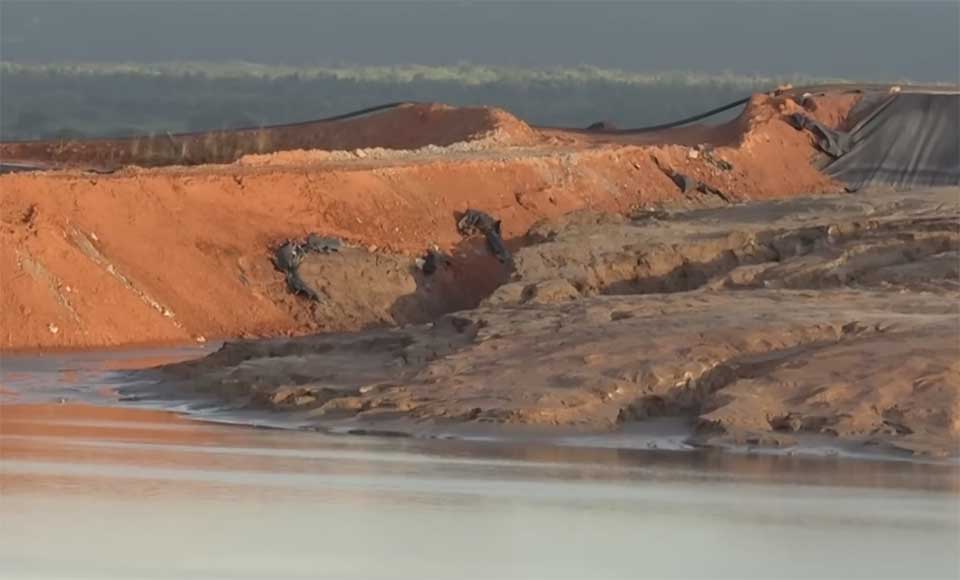
When the Sino-Metals Leach, a Chinese-owned copper processing company, experienced a tailings dam collapse in February in Zambia, the government, through the Ministry of Green Economy and Environment, dismissed reports that 1.5 million cubic meters of acid waste had been released. Officials also claimed that water in the surrounding areas remained safe for drinking, even though laboratory tests indicated excessive levels of heavy metals in several locations.
In June, an independent assessor, Drizit Zambia Environmental (Pty) Ltd, which had been appointed to conduct an environmental audit, reported that the amount of toxic sludge released was actually 30 times higher than initially disclosed. However, instead of reviewing or verifying these findings or undertaking its own assessment, the government sided with Sino-Metals and dismissed Drizit’s report as false
Ordinarily, the government would permit an independent inquiry before taking a position, but in this case, it appeared to defend the company prematurely.
Several lawsuits have since been filed by different groups in the Zambian courts against Sino-Metals.
For President Hakainde Hichilema, who faces re-election in 2026, the incident presents significant political risks that could influence how voters perceive his administration’s handling of foreign investment and environmental accountability.
To unpack the politics and implications of this matter, I spoke with Dr. Emmanuel Matambo, a scholar and visiting research fellow at the Center for Africa-China Studies at the University of Johannesburg.
OBERT BORE: Dr. Matambo, help us understand why the Zambian government was quick to dismiss the report by the independent assessor, Drizit, and why it appeared to side with Sino-Metals before the process was complete?
EMMANUEL MATAMBO: What has been happening in Zambia should not really be surprising. It is perhaps surprising to some people because it is happening less than a year before the general election in August 2026. But why is the Zambian government seemingly siding with Sino-Metal and NFC (Non-Ferrous Corporation), both of which have been sued by 150 Zambian litigants?
The reasons are pragmatic on the part of the Zambian government. Of China’s investments in Zambia, about 80% are dedicated to mining and related activities. The Chinese have invested heavily in Zambia’s mines.
To understand this, we must recall the events around 2008, during the global recession. Some of Zambia’s mines had been abandoned for years, and the Chinese stepped in to revive them. At that time, China was viewed as a savior. Today, more than 80% of Zambia’s foreign revenue is generated through mining, mostly copper mining, where Chinese companies dominate.
Losing such a major partner would be a serious blow to the economy. From an economic standpoint, therefore, it makes sense for the government to side with Sino-Metals, because who would replace them if they were forced out?
Just to add context, the farmers suing Sino-Metals and NFC are demanding $80 billion in damages. Zambia’s GDP is about $25 billion, so that claim is enormous but symbolic. The companies claim to have compensated farmers with 14 million kwacha, which is less than US$67,000. This is just a drop in the ocean compared to the scale of the damage.
OBERT: Given the economic context you have given and the deep Zambia–China relationship, what are the political implications of the government siding with the company? How does this decision affect public perception? What are Zambians feeling about how the government has handled this crisis?
EMMANUEL MATAMBO: That’s a very important question because it highlights the complexity and multilayered nature of Zambia’s relationship with China. Since diplomatic relations were established about 30 years ago, it was mainly state actors who shaped the narrative.
Like any relationship, it had blemishes, but these were often resolved quietly behind closed doors. Early Chinese arrivals in Zambia came through official government channels, diplomats, technical experts, or medical teams working on national cooperation projects who returned to China after their contracts.
However, from around 1998–2000, this relationship became multi-pronged. We began to see private Chinese entrepreneurs and investors arriving in Zambia independently of the Chinese government. This created new dynamics, often referred to as “people-to-people” relations
At this level, the China–Zambia relationship is not as positive as official narratives suggest. Following this latest lawsuit, many ordinary Zambians, especially those affected by the mining spillage, perceive China as predatory towards the safety of Zambian communities and even Zambian workers in Chinese-run mines.
So, there’s a clear discrepancy between the government’s stance and public sentiment. While the government continues to defend Chinese companies, many Zambians feel neglected and exploited.
OBERT: With those sentiments among ordinary Zambians, how do you think this issue could affect the 2026 elections?
EMMANUEL MATAMBO: There is a historical precedent, Obert. Let’s go back to 2005, ahead of another crucial election year in 2006. Dozens of Zambian workers died in an explosion at a Chinese-owned mining explosives company in the same Chambishi area where this current disaster occurred.
The opposition at that time, led by Michael Sata (Zambia’s fifth president), capitalized on the tragedy to highlight the dangers of Zambia’s close ties with China. His party, founded in 2001, had only received 3% of the vote that year. But by 2006, by tapping into anti-Chinese sentiment, Sata’s votes rose to over 20%, making his Patriotic Front (PF) the main opposition party.
By the time he became president, his party had secured 90% of parliamentary seats in the Copperbelt and Lusaka provinces, the areas where Chinese investment is most visible. That demonstrates how powerful the China issue can be politically.
This current incident has significant political ramifications, especially for the ruling government. The Copperbelt Province, one of Zambia’s most populous and urbanized regions, wields enormous electoral influence. Urban voters in Africa, including Zambia, tend to vote based on economic issues rather than ethnic loyalties, and they often favor the opposition.
If the government continues to downplay the issue, by, for example, claiming that the 14 million kwacha payout was sufficient, it risks alienating many voters who feel undercompensated or ignored.
Many believe that the compensation was insufficient and does not reflect the scale of environmental and economic damage caused.
If the government fails to address these grievances sincerely, the Sino-Metals disaster it could become a major political liability heading into the 2026 elections.