Indonesia is strengthening its position as a global center for halal business, a market currently worth $3 trillion and projected to reach $4.5 trillion by 2030. Halal refers to products and practices that comply with Islamic law, including food, pharmaceuticals, cosmetics, and financial services, ensuring they are permissible for Muslim consumers.
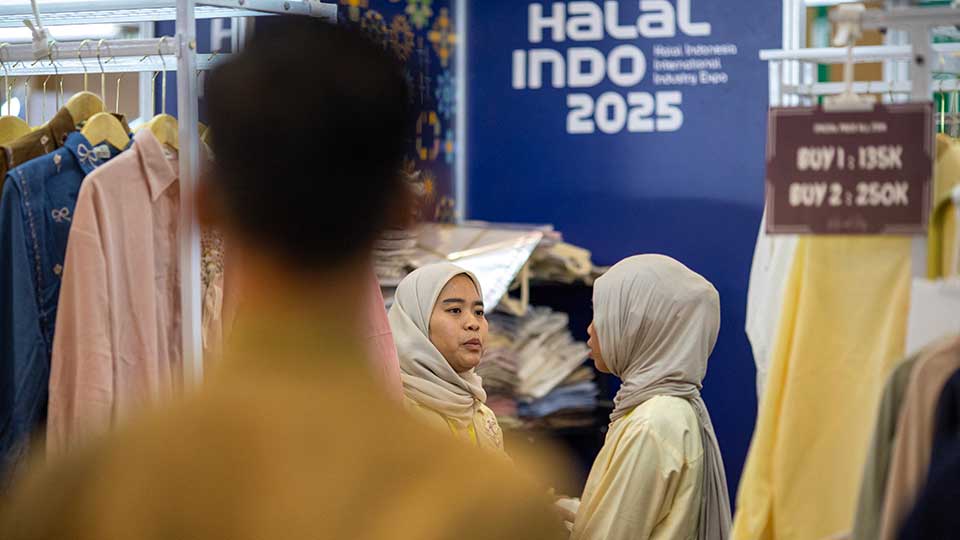
At a major halal festival held last month in Tangerang, near Jakarta, the Halal Indo 2025 x Industrial Festival drew 27,000 visitors and 346 exhibitors, with deals totaling $450 million.
For Indonesia, the world’s largest Muslim-majority country, the festival was a statement of ambition — a showcase of its drive to expand its leadership in the global halal industry.
The festival also showed how important partnerships are. Among others, Indonesia signed an agreement with China’s Food and Drug Corporation Quality and Safety Promotion Association (FDSA). The two sides will work together on halal industry growth, research, training, and business support. The idea is to push more companies to build partnerships and grow together.
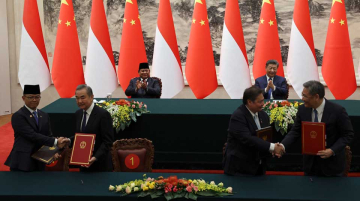
This builds on earlier steps. In November, President Prabowo Subianto went to Beijing. There, Indonesia and China agreed to strengthen food security and halal trade. Soon after, Jakarta hosted a food fair that brought together 175 companies from both countries.
The two have also agreed to mutual recognition of halal certificates. Indonesia’s halal authority (BPJPH) now accepts certificates from 37 agencies in 16 countries, including China. That makes trade smoother and avoids extra checks.
China itself has been moving fast in the halal industry. Indonesian auditors visiting places like Shanghai and Shandong saw efficient certification systems. Chinese exporters also get help from groups like the American Halal Foundation to reach buyers in Asia and the Middle East. For China, halal is both a business and regulatory matter.
For Indonesia, cooperation with China offers opportunities to share knowledge, streamline certification, and expand markets, even as companies from both countries remain active competitors in global trade. China brings not only technology and logistics but also a sizable domestic halal market, valued at over $77 billion in 2024 and projected to grow about 10.8 percent annually through 2034, according to China Briefing.
Pharmaceuticals are another area where Indonesia can learn from China’s experience. By October 2026, all over-the-counter drugs in Indonesia will be required to carry halal certification, creating an urgent need for robust regulatory and auditing systems.
During a visit to Shenzhen last year, Indonesian halal authorities examined China’s certification practices and regulatory frameworks, noting efficient processes that could inform Indonesia’s own implementation.
By collaborating on training, standards, and digital certification systems, Indonesia can accelerate its rollout of halal-certified medicines while ensuring consistency, quality, and consumer trust.
In Surabaya, one of Indonesia’s largest cities, halal-certified Chinese restaurants have grown by 150 percent since 2018, according to the Surabaya City Department of Industry and Commerce. Events like the Republika Hijriah Food Fair, where halal dim sum and noodles are showcased, bring together both Muslim and Chinese communities.
Finance could also be a strong area of cooperation. China’s Belt and Road Initiative includes Islamic finance projects in Central Asia and the Gulf. Ningxia, an autonomous region in northwest China, for example, is building Sharia-compliant financial hubs.
Indonesia, with a $1.5 trillion economy and extensive experience in Islamic finance, could collaborate with China on cross-border sukuk (Islamic bonds) and halal financing. Trade, infrastructure, and finance can all link under the halal umbrella.
Still, there are obstacles. Only about 30 percent of Indonesian small food businesses are halal-certified. Many face high costs, slow bureaucracy, and a shortage of trained auditors. Certification is more than a rule—it builds trust. Working with China through joint labs, digital systems, and training could help small businesses catch up.
Indonesia’s halal rise is both an economic and cultural story. By combining their population sizes, market legitimacy, and regulatory frameworks with China’s technology, logistics, and a substantial domestic halal market, the two countries can set global standards, open new markets, and strengthen regional ties. Halal is not only a trade opportunity — it is a platform for cooperation, innovation, and shared growth that could improve lives across Asia.
This article was co-authored by Yeta Purnama, a researcher at the Center of Economic and Law Studies (CELIOS), and Muhammad Zulfikar Rakhmat, Director of the China-Indonesia Desk at CELIOS.