When talking about Africa–China relations, one is always moving along a sliding scale. There are myriad interactions with Chinese entities that concern only individual African countries, segueing into trends affecting the whole continent and sliding further into global dynamics shaping the developing world, of which Africa is the heart.
The Africa-China relationship is its own thing, but Africa’s fate can’t easily be separated from factors affecting the wider Global South, and in some ways prefigures them.
The U.S. airstrikes in Nigeria, while reportedly taking place in coordination with the Tinubu government, were an indicator of a wider trend: U.S. adventurism is back. Africa has arguably again slipped into its role as a laboratory for the world. The Nigeria strikes, the highly uneven US-DRC minerals-for-security deal, the blocking of South Africa-led G20 processes, the tolerance of proxy interventions in the Sudan war, and Israel’s move to recognize Somaliland after years of Republican lobbying, were all signposts pointing to Caracas.
The Trump administration’s attacks on Venezuela have instantly reshaped the geopolitical relationship between the Global North and Global South. The intervention killed at least forty people, including civilians, and included the seizure of President Nicolás Maduro and his wife. Trump said the United States would “run the country” in preparation for a transition. At present, we don’t know if that would include a military occupation. Trump explicitly didn’t take the option off the table.
These shifts, of course, came in the wake of the Gaza genocide, the most potent message from Washington and its allies to the Global South that Western power has turned against international law and that no tactic is off the table in projecting its influence.
China faces a complex set of options in this context. It has denounced the attack in Venezuela and has generally rhetorically championed Global South sovereignty. However, the interaction between the party-state and Chinese companies has also complicated this positioning, with Chinese arms being used in massacres in Sudan, which arguably also enjoyed tacit U.S. consent.
This year will be a key test of how China will step into these growing South-North contestations. The fact that Maduro was seized hours after meeting with a Chinese envoy, with some speculating that the timing was itself a gesture targeting Chinese influence in the region, draws China even more deeply into the emerging North/South geopolitics rooted in earlier colonialism and therefore China’s own Century of Humiliation.
South-South solidarity will only be part of the story. Any move from Beijing will necessarily foreground Chinese priorities, not least how it projects power within its immediate neighborhood.
China’s responses to Africa’s entanglement in emerging North/South politics will therefore also be strategic. However, it is also underlain by three large multi-year trends that act to cement the two closer together, no matter what happens geopolitically.
Continued Internationalization of the Yuan
The news last year that Kenya will restructure its dollar-denominated debt into Chinese yuan marked a significant advance in the global use of the Chinese currency. Since then, Ethiopia also announced that they are in talks with Chinese lenders to enact a similar conversion. In addition to avoiding shifts in local currencies against the US dollar, the move made a larger sense: why take on additional conversion costs if one is paying Chinese lenders for services rendered by Chinese companies?
A similar logic is emerging in the opposite direction. The Bank of Zambia announced that it has started accepting royalty payments from foreign companies in the Chinese currency. This strengthens China’s role as a major copper buyer and would arguably smooth the way towards other forms of collaboration with Chinese companies, as the government builds up its RMB reserves. Zambia is the first African country to make this move, but probably not the last.
Solar
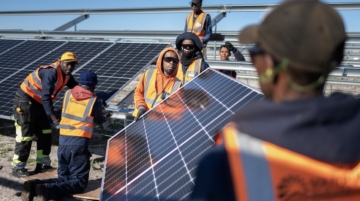
The collaboration between China and the Global South on solar power, despite being largely driven by private sector actors on both sides, has been one of the most striking soft power successes for China in recent times. The way that China became central to energy transitions in countries like Pakistan and South Africa even without allocating major development funds set up a stark contrast to the Trump administration’s open appropriation of Venezuela’s oil, while also implicitly bolstering China’s wider messaging of modernization to the Global South.
Solar has been such an effective vector for a wider modernization message that it will likely keep growing as a key field of engagement. In the process, the Global South helps to ease the dog-eat-dog competition within the Chinese solar sector and reinforces the wider centrality of Chinese tech and standards.
Digital South
As part of the broader appeal of Chinese tech as a vector of outreach to the developing world, the launch this week of the Digital South training schemes under the Global Development Initiative further emphasizes the unique messaging role technology plays for China in the Global South. Led by the China International Development Cooperation Agency (CIDCA), China’s main development arm, the initiative will run 200 programs on the digital economy and artificial intelligence throughout the Global South. The training will help to establish Chinese AI governance models throughout the Global South as part of Beijing’s Global AI Governance Initiative and help to link emerging digital economies to the Chinese market.
These megatrends will likely weave Chinese influence into Africa and the wider Global South more conclusively than any rhetoric of South-South solidarity. Beijing’s laser focus on development, technology, and modernization won’t only strengthen ties with established allies in the developing world, and Africa specifically. Training, electricity, and jobs remain Africa’s key priorities, and following the withdrawal of U.S. aid, China is the only game in town for many African governments.
It also means that any pro-U.S. turn by a developing country government will always come with a Chinese asterisk.
Cobus van Staden is CGSP’s Head of Research.